The Modern Tech POV: Vermeer Corporation's Brent Westerkamp
A conversation between Freshworks CEO Dennis Woodside and Vermeer’s director of IT services

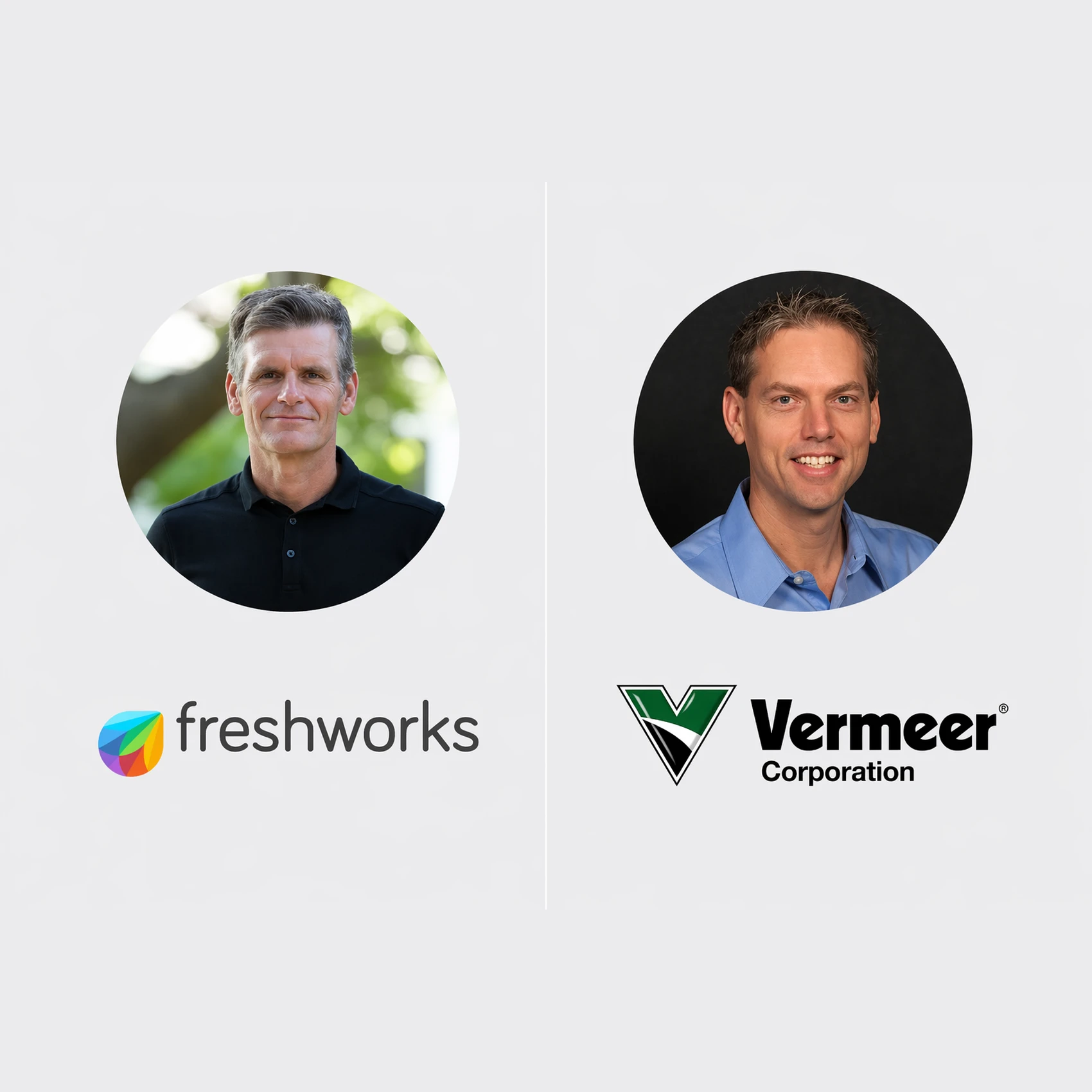


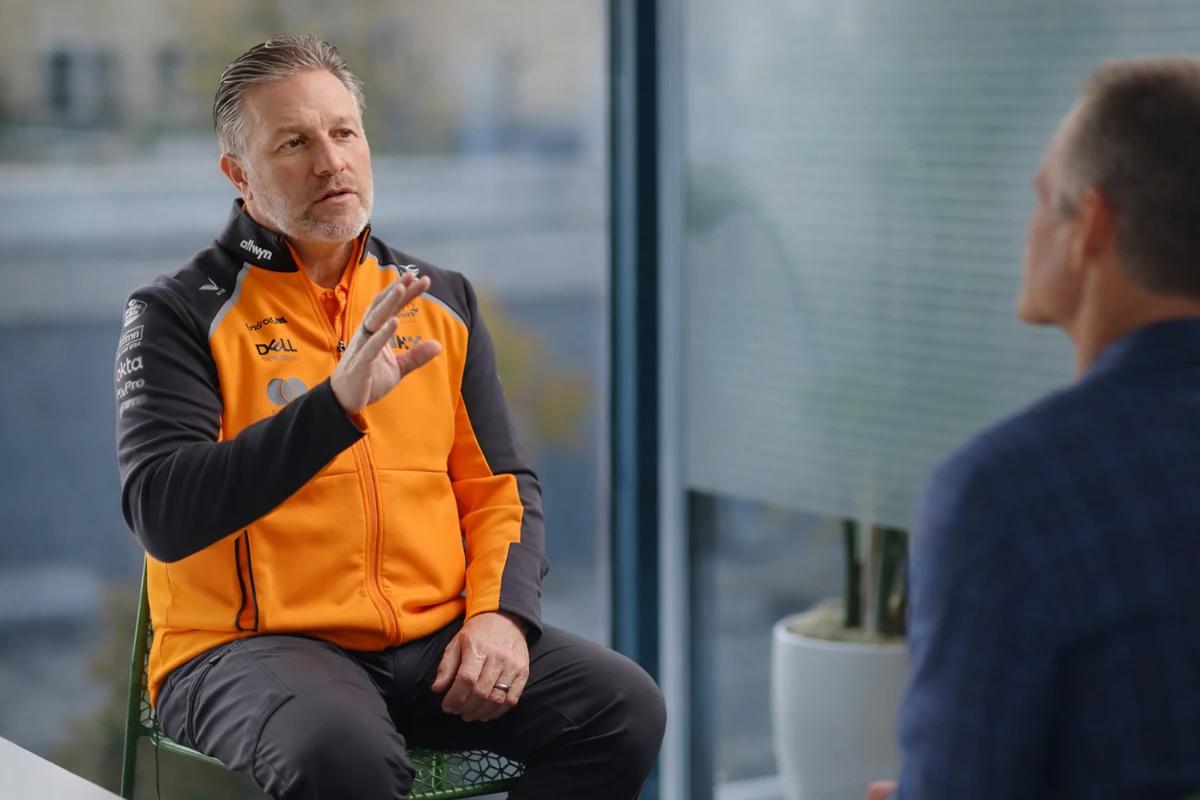
Editor's note: Highlights below from Freshworks CEO Dennis Woodside's latest "The Modern Tech POV" episode featuring Vermeer Corporation's Director of IT Services, Brent Westerkamp. Watch the full episode here.
In manufacturing, a technology failure can stop production. Costs pile up in real dollars. This shapes the way Brent Westerkamp thinks about every investment his team at Vermeer Corporation makes.
During a recent conversation with Dennis Woodside, Westerkamp traced how Vermeer's IT function grew from 11 people to more than 165, morphing from a cost center to a strategic driver of the business across a complex, multi-site operation. Now, as the company expands its use of AI, cost and caution go hand in hand with scale: In industrial environments, says Westerkamp, the risk of moving too fast is real, but he points to wins in automation that are giving a real-time view on SLAs and customer satisfaction.
Read the full transcript below, and subscribe to future “The Modern Tech POV” episodes on YouTube.

Podcast transcript (lightly edited):
Dennis:
Hi, I'm Dennis Woodside, CEO of Freshworks, and today I'm joined by Brent Westeramp, director of IT services at Vermeer, an industrial and agricultural equipment manufacturer based in Pella, Iowa, that serves customers in over 60 countries that are essential to agriculture and infrastructure. They've been around since 1948, and they are proudly family-owned. Their mission all that time has been to fill a need. Now, manufacturing has a constraint that most enterprise environments don't. You just can't pause the business or the manufacturing line to fix the technology. When a line goes down, the cost is immediate, and it's measurable. That pressure changes what leadership actually means, and it raises the bar for every decision about where to invest, where to automate, and when to hold back. Brent's team supports complex operations across multiple sites without the luxury of adding headcount every time the scope expands. He's had to figure out where AI and automation genuinely earn their place and where the risk of getting it wrong is too high to move fast. So that's where we're going to dig in today, what it takes to modernize it when the stakes are operational. Thanks for joining us, Brent. Let's get into it.
Brent:
Thank you, Dennis.
Dennis:
My first question is, manufacturing used to be a lot about keeping the lights on and handling help desk tickets, but that's not the full picture at all today. So, maybe you can talk a little about how it has evolved at Vermeer and how the expectations of the business have changed.
Brent:
I've been at Vermeer for almost 28 years. I started out helping install Windows 95 PCs to replace AS400 terminals. Through my career, I've seen a lot of change, but one thing from an IT perspective that has been constant is that manufacturing is the number one priority. So, doing whatever we can to enable our lines to produce products. And we've just continued to grow from an IT organization. I was here when we had 11 people in IT. Now we're around 165. So, seeing the maturity and growth of what the organization has put into IT and technology investments has been great, but we've become more of a center for delivering technology to the business. We used to be kind of that cost center, where we had to keep the lights on and just make sure things were still running. But we've been part of helping the transition to make us a more strategic asset for the organization, and it's been fun to help the company through that journey, while also providing the excellent support we've been doing for the 27 to 28 years I've been here.
Dennis:
One thing people outside manufacturing might not understand is how important technology and information systems have become to it. I don't know how many products you have, but you have a lot of products, and they're not simple products. They are pieces of equipment that, in some cases, are as large as a tractor, often towed behind one, and are also very much technology-enabled. So, can you talk a little bit about the importance of it in creating a nimble, fast-moving manufacturing line and how it's a lot more than just kind of keeping things up and running, but it's really integral to how you plan manufacturing and how you plan your supply chain.
Brent:
Yeah, I would say a big piece of a lot of the improvements hasn't necessarily been technology over the years through manufacturing. It's been our Kaizen practice to work through finding a better way to remove that waste within the manufacturing lines and to ensure that the assembly can happen as efficiently as possible. And as we now bring technology into some of those lines too, from digital instruction, from paper manuals that they had previously years ago. The amount of product that can be produced has definitely increased the line efficiencies, and being able to display metrics at the end of the lines for how the welders are doing, just the information that's available because of technology, to help drive those efficiencies. It's fun to see how all of that drives progress.
Dennis:
Yeah. how how much it enables Kaizen really because without the information how do you get better many IT teams today everybody's being asked to do more with less I think at the same time you've got to compete with much bigger competitors around the world and I mean you've got John Deere in the US but there's big manufacturers in Europe as well h how do you manage that tension between being being the the the kind of the challenger your faster growing but smaller organization compared to some of these giants. How do you manage that tension with not having massive numbers of people, with the fact that you still have to do very big things?
Brent:
I think our relationships with customers are very important, and our dealership network plays a huge part in that, along with our support for the dealerships. So, as we've continued to grow with technology, right, getting our dealerships more intertwined with data and technology platforms that they can use to help manage and sell equipment, but then also from the sale of the dealership to a customer, just the products that we've also equipped our customers with to be able to manage whether it's a single machine or a fleet of machines has been like a large success for us over the last few years, we we don't say that we have to go compete I would say against like the John Deers and some of the larger organizations because in a lot of ways we we only make a handful of products that overlap with with them. We fill a lot of niche product areas to where when there is a need that we find in the market, we're quick and nimble to identify what product could fill that need and get it in like prototypes for customers to give us feedback on. So we have a pretty quick process, I would say, to get that accomplished.
Dennis:
So, just going back to the manufacturing challenge, you've got the challenge of providing a certain level of services support systems, and then you've got the operational technology, which is the systems that actually operate the plant floor. I'm curious as to where it is the IT team's responsibility, and when does that operational technology kick in? And do you see that line getting clearer or fuzzier as new technologies like AI come into play?
Brent:
It's been pretty fuzzy over the past years, to be honest. I do think we're in a good place where we have things we're figuring out. Like the organization I lead is IT services. We also have another director, my counterpart, who leads our digital products team within IT. And so we have a digital products team that's aligned to our advanced manufacturing or OT team, and we also have technical folks within our OT advanced manufacturing team. So the three of us have to really communicate well and understand how we're there to help each other. The initiatives that we have right now is we've been working heavily on getting like shop floor data collection so that we can do better at displaying metrics and have that available for the lines. So whether it's connecting devices to the network, ensuring that there's communication, what's needed, making sure that it's got proper security, that the network's segregated away from other networks and then working with digital products on the application side, when you've got three teams, it can be complicated, but we're in a much better space than where we were a handful of years ago with the OT team wanting to do more things on their own without it, and trying to get them and us to work together so that we can drive progress holistically and make good strides for the organization.
Dennis:
Now we have to, of course, talk about AI. There's a lot of noise and hype about AI. I'm sitting here in Silicon Valley, which is the home of the hype around AI, and everybody's got a story, but I would love to hear from you. Where are you seeing AI and automation actually work, and where do you think that it's still in the future?
Brent:
We have taken the approach to really help train our team members on the productivity tools with Copilot, and the adoption rate that we have there is, according to Microsoft, one of the highest adoption rates that our account team is measuring. So, from that regard, we have a high adoption rate. Now, when it comes to using AI within different tools, translations, and helping get answers out of product manuals, we've done some of the, I would say, things that are more readily available from an automation tool, with agents. We're definitely diving into that, but we don't have anything that would set us apart from anyone else.
Dennis:
So, I want to turn it a little bit to Freshworks. One of the things that we hear from IT leaders is that the time to implement when you make a software decision is very important, and in the past, the accepted norm was that the timeline had to be quite long. You had to migrate from something else, and it always took longer than people thought. And then that interim period is when people start losing faith, and you lose momentum. Tell us a little bit about the ramp at Vermeer when you decided to move to Freshworks. How did that work? When did you see value relative to when you made the decision?
Brent:
One other significant change that we made within our organization is trying to make sure that we are getting products in internal team members' hands iteratively. So what I mean by that is trying to get some base functionality in place so that we can continue to develop and iterate on the solution just along the way. So, we took about I would say 3 months to try to get a lot of our self-service catalog items built out, and when we released that, I would say we continued to iterate on it and develop. One of the things that took a little bit of time is we wanted to make sure we had a lot of our asset information imported because if there's a ticket right that someone needs support with a device, having that information accurate was going to be critical too to make sure that we could provide the right level of support. So, between building out our self-service catalog and then importing our asset data, that was kind of a three-month effort before we released it to the organization.
Dennis:
Last question for me. If you’re thinking about talking at the end of the year about what it has achieved, what you've contributed over the course of the year, what are the kinds of metrics or results that you tend to talk about within the IT organization at Premiere when you're talking to your CFO or your CEO?
Brent:
I would say different things. So from the digital product side, the business process improvements that they're able to deliver, there's measurements around like how many man hours that would end up saving and then they kind of track how many FTEs, full-time employees that would end up saving just by delivering like a new application solution or with the Kaizen doing a business process improvement event to where we can take out wasted steps. So that's a key measurement from their side. From the IT services side, we're trying to better track uptime because we have an external-facing platform that's important for us to keep running. So those metrics have become more important than ever, not just for internal manufacturing purposes but also for an application that our dealers and customers rely on heavily. We also track through fresh works of fresh service, our internal metrics for things like SLAs on tickets, and our customer satisfaction rate. We didn't have a lot of those capabilities with our previous solution. A lot of those metrics were manual, but we just love how easy those are to access within Freshservice.
Dennis:
Excellent. Well, Brent, I want to thank you. When I just reflect on the conversation, I think one of the many things that's interesting is how how diverse the needs are at Vermeer on or the demands on the IT department, whether you're talking about the partner network and partner communications or the manufacturing lines or design and then of course there's the normal corporate corporate support that you provide and and I think the a theme across all that is it can't go down and it and it has to be reliable, it has to be measurable. and obviously has to be more and more effective over time. So really appreciate the time and appreciate a little bit of a window into the manufacturing environment that you're operating in at Vermeer. So to everybody else listening, love to hear how you're navigating similar pressures. Just drop a comment below, and look forward to more of these conversations coming soon. Thanks.
Brent:
Thank you.