How predictive AI turns ITOps from reactive to proactive
IT teams are shifting from firefighting to forecasting, but only when the data, workflows, and trust in automation exist


Key takeaways
Predictive AI doesn’t just prevent outages. It also changes what the workday looks like for IT teams, trading constant firefighting for planned, judgment-based work.
The technology only works as well as the data and workflows underneath it—fragmented ticketing systems and siloed teams undercut it before a single model gets deployed.
Most organizations today sit between forecasting and automation. That’s changing, but unevenly, and mostly for narrow, well-understood failure types.
How predictive AI turns ITOps from reactive to proactive
IT teams have gotten very good at fixing what’s broken. Predictive AI could help them get better at something else: ensuring fewer incidents occur in the first place.
For years, traditional IT operations have followed a familiar pattern. Something breaks, someone gets an alert, a ticket appears, and eventually it’s fixed. Until it happens again. Predictive AI in IT operations (ITOps) helps IT teams spot potential problems before they become incidents. It uses machine learning models trained on historical incident, performance, and infrastructure data to detect patterns, forecast disruptions before they occur, and trigger automated remediation.
Instead of responding to outages after users report them, IT teams can anticipate issues and act early—shifting operations from reactive firefighting to prevention and, eventually, toward self-healing infrastructure.
Why reactive ITOps fails modern enterprise teams
The traditional ITOps model gets harder to sustain as IT environments become more complex. Now, it doesn't hold up against hybrid cloud, microservices, distributed teams, and infrastructure that changes weekly rather than yearly.
Three forces make the reactive model unsustainable. Complexity has outpaced human monitoring capacity, since a single transaction can touch a dozen services that no engineer can track in real time.
The cost of downtime keeps rising as more revenue and operations run through digital systems, so an outage now has immediate, measurable business impact. And ticket volume grows faster than headcount, so teams triaging reactively stay perpetually behind, treating symptoms while the underlying pattern repeats next week.
Reactive ITOps also has a structural flaw: it only generates value after something has already gone wrong. Every incident report is a well of information that traditional monitoring fails to use to prevent a recurrence. Predictive AI closes that gap by treating incident history as training data rather than a filing cabinet.
What predictive AI means in an ITOps context
Predictive AI applies statistical and machine learning models to operational data such as incident logs, performance metrics, change records, and infrastructure telemetry to anticipate problems before they affect users. It differs from basic monitoring, which reports that something is wrong right now, and from static alerting, which fires only after a threshold is crossed.
In practice, the model learns what typically comes before a failure—what usually precedes a database timeout, what a memory leak looks like hours before it crashes a service—and watches live data for the same signature. That’s a different job than basic monitoring, which tells you something is wrong right now, or static alerting, which fires only after a threshold has already been crossed.
That changes what teams are actually optimizing for, and it changes what the job feels like day to day. Reactive tooling is built around mean time to resolution, usually under pressure. Predictive tooling is built around how many of these incidents can be kept from reaching a user or an engineer’s queue at all. It asks for data, workflows, and a level of trust in automation that most ITSM deployments were never built around.
So what can predictive AI actually do?
The technology becomes most useful when it connects prediction to action. Five capabilities form the foundation.
First, predictive AI can find patterns in historical data. Every incident leaves clues like a recurring error code, a particular sequence of performance changes, or a change that repeatedly precedes a service disruption. Predictive models can sift through large volumes of tickets, logs, changes, and performance data to find patterns that humans may miss.
Second, it can spot trouble before it becomes an incident. Once the model recognizes patterns that typically lead to problems, it can watch for those signals in real time and flag potential issues before they disrupt users.
Third, it can help IT take action. Instead of adding another alert to an already crowded queue, predictive AI can connect the dots and trigger the next right step. It can create a ticket, bring the right team into the loop, surface the context they need, or recommend how to address the problem. Freshservice’s incident management tooling is built to route that context automatically, so the engineer who does get pulled in isn’t starting from zero at 2 a.m.
Fourth, it can handle routine fixes. When IT knows the right response and the risk is low, AI can handle the fix automatically. It might restart a service, adjust capacity, or resolve a known issue before it turns into a disruption. That gives IT teams fewer fires to fight and more time to focus on work that actually needs their expertise.
Finally, it gets smarter with every outcome. Every prediction creates another piece of operational history. Teams can evaluate whether the prediction proved accurate, whether the recommended action worked, and whether the system mistook noise for a meaningful signal.
Real-world scenarios where it matters
Take an e-commerce platform heading into a seasonal sales event, and historical data shows that checkout latency degrades whenever concurrent sessions cross a certain threshold, combined with a specific database connection pool size. A model trained on prior peak-event flags, 48 hours out, flags that current traffic projections will hit that combination during the event's opening hour.
Instead of waiting for checkout to slow down and generate a wave of support tickets, the system surfaces the forecast to the infrastructure team with a recommendation to scale the connection pool and pre-warm additional application instances. The fix happens before a single customer notices a delay—catching a capacity constraint ahead of peak load rather than diagnosing it mid-outage.
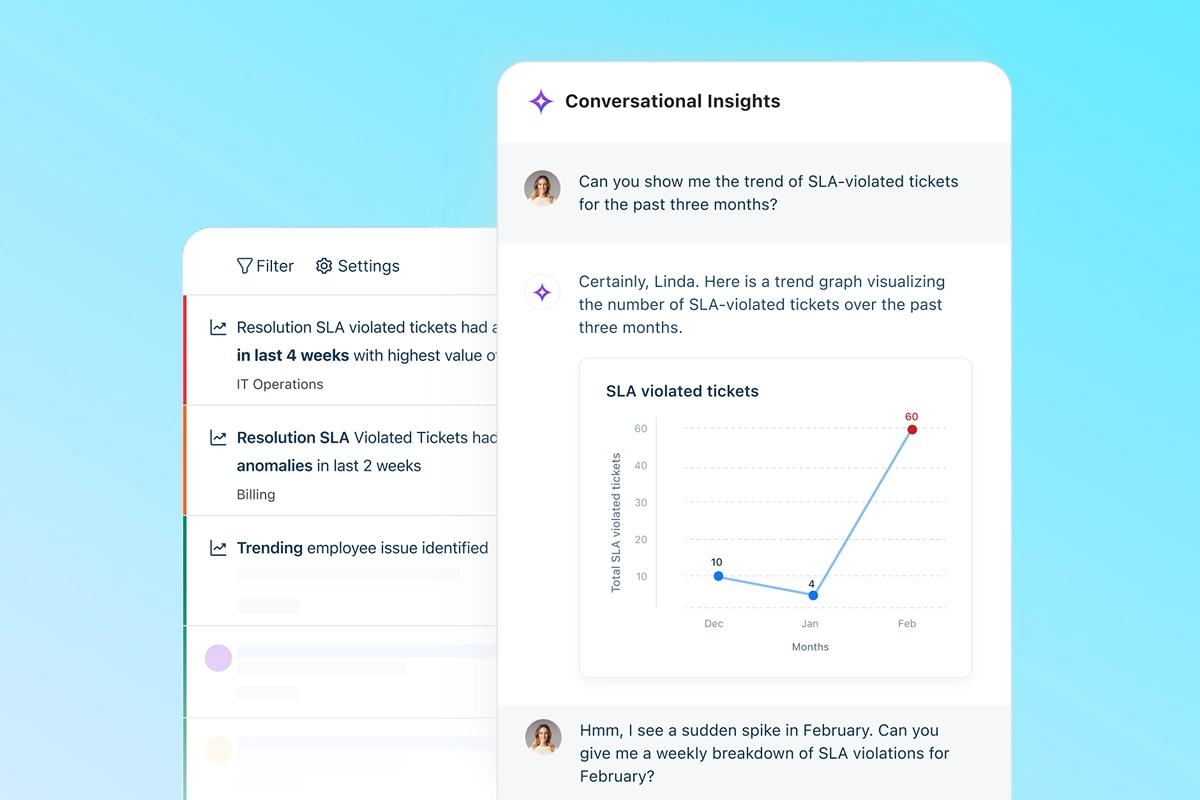
The same mechanism applies beyond capacity: predicting hardware failures from disk health data before drives fail, flagging certificate expirations days ahead based on renewal history, or spotting a security misconfiguration pattern that has historically preceded a breach. Service desks with built-in AIOps insights, like Freshservice, can surface these patterns automatically each morning, giving teams a consolidated view of overnight anomalies instead of a growing ticket queue. In healthcare and other environments where systems support patient care or safety, that head start matters more than convenience, where a missed prediction there carries clinical risk, not just inconvenience.
Why AI is only as good as the IT underneath it
Predictive AI fails quietly when the groundwork isn't set up. Three conditions determine whether an implementation succeeds.
Data quality and history. Models need clean, structured, sufficiently long historical data to detect real patterns rather than noise. Organizations with fragmented tooling—separate ticketing, monitoring, and CMDB systems that don't share a data model—often discover their "history" is really three incomplete histories that don't reconcile. Incident, asset, and performance data typically need to live in a connected system before predictive AI can work.
Cross-functional readiness. Predictive AI surfaces problems that cross team boundaries; a forecast might implicate networking, application, and database teams simultaneously. If those teams operate in silos with no shared incident taxonomy, the prediction has nowhere useful to land. Organizations already running enterprise service management, where workflows and escalation paths span departments, tend to adapt faster.
Tolerance for automated action. Moving from forecasting to automated remediation requires leadership comfort with systems acting on predictions, not just reporting them. Teams start with predictions that generate a ticket or alert, build confidence in accuracy over months, and only then permit automated fixes for well-understood, low-risk failure modes. Skipping that trust-building step is the most common reason predictive AI initiatives stall after a promising pilot.
Without these conditions, predictive AI degrades into another dashboard nobody checks. With them, it becomes the mechanism that makes proactive ITOps operationally real rather than aspirational.
Where predictive AI is headed for IT teams
Most organizations sit somewhere between forecasting and partial automation, where models flag risks and humans decide. Over the next few years, expect more of that decision layer to be compressed into narrow, well-understood failure categories: capacity scaling, certificate renewal, and routine patching triggered by predicted vulnerability windows.
That doesn't mean IT teams disappear from the loop. It means their time shifts from investigating why something broke to defining which categories of prediction are safe to act on automatically and which still require judgment. The organizations that get the most value will be the ones that fixed their data foundations and cross-team workflows early, since predictive AI amplifies whatever operational maturity already exists.