5 ways to automate the holiday customer service rush with Freshdesk AI
AI absorbs routine work behind every ticket, so support teams have more time for the moments that need a human




Key takeaways
The holiday rush compresses the time teams have to understand and resolve customer problems.
The next phase of automation is about completing work, not simply generating answers.
AI is most valuable when it gives agents more time for judgment, empathy, and complex problem-solving
As holiday demand rises, AI can take care of repeat questions, routine actions, and the work behind every ticket, giving support teams more room for the moments that need a human.
For customers, the holidays are built around anticipation. They are waiting for the gift to arrive, the payment to go through, the refund to appear, or the flight that will take them home.
For customer service teams, the season can feel very different. One day, the queue looks manageable. The next, it is filled with delivery questions, payment problems, booking changes, and increasingly anxious customers.
The questions are not always new. What changes is the volume, the urgency, and the consequence of getting the answer wrong. This is where AI can make a meaningful difference.
Freshworks research found that 41% of customer service teams say AI has significantly improved their ability to handle seasonal demand. Additionally, nearly 47% have avoided hiring more seasonal agents, while 40% have reduced overtime.
But the opportunity is bigger than absorbing ticket volume. The new generation of holiday customer service automation solutions can identify what customers need, carry out routine actions, and support agents while the conversation is still happening.
Here are five ways teams can put that capability to work.
1. Let AI handle the repeat questions
Every holiday season produces its own greatest hits.
Will this arrive before Christmas? Can the delivery address be changed? Is this product still available? What is the return policy? Where is the refund?
These questions are important to the customer. But answering them one at a time is not the best use of an agent’s attention.
Freddy AI Agent can respond to common requests across channels such as web chat, email, WhatsApp, Instagram, and Facebook using the company’s approved knowledge. It can ask follow-up questions, understand the customer’s intent, and pass the conversation to an agent when the issue becomes more complex.
That last part matters.
Freshworks CMO Kady Srinivisan: Beyond the AI pilot in customer service
“Where is my order?” may be solved with a tracking update. “My order says delivered, but it is not here” requires investigation. Effective automation needs to recognize the difference.
Hobbycraft has seen what this can look like in practice. The U.K. arts and crafts retailer uses Freshdesk to handle up to 30% of customer queries with AI. It also resolves 82% of tickets during the first interaction and has reduced response times by 30%.
At holiday volumes, every routine question resolved by AI creates more room for the exception that needs a person.
2. Route the moment, not just the ticket
Not every holiday request carries the same weight.
A sizing question can wait a little longer than a failed payment during a flash sale. A general baggage query is different from a traveller whose flight leaves in three hours. A return-policy question is not the same as a missing gift on December 24. Yet these requests often enter the same queue.
Freshdesk can automatically categorize tickets by intent, product, language, sentiment, and other business-specific factors. Auto Triage identifies what the customer needs, while Omniroute distributes work based on skills, availability, workload, and channel.
That allows teams to design routing around the customer’s situation rather than the order in which a message arrived. Urgent payment issues can reach the right specialist. Conversations showing rising frustration can receive greater attention. Self-service or AI, meanwhile, can handle routine questions.
Customers do not see the routing logic. They simply reach someone who can help, without being transferred repeatedly or having to explain everything again.
3. Move from answering questions to taking action
For years, customer service automation has been good at explaining what customers need to do next. But explanations are not resolutions.
A customer does not want to read three paragraphs about the returns process; they want to initiate the return. They do not want a link to the order portal; they want to know whether the delivery address can still be changed. Agentic AI moves automation from information to action.
Freshdesk AI can work with connected commerce, payment, logistics, and customer systems to retrieve context and support approved actions. With Freshdesk’s Model Context Protocol capabilities, AI can securely access information and perform governed tasks across external applications.
Consider a customer who has entered the wrong shipping address. An AI agent can verify the order, check whether it has entered fulfillment, update the address when allowed, and confirm the change. If the package has already shipped, it can bring in a human with the details already collected.
This is particularly valuable during the holidays because many customer problems have a short window in which they can be fixed.
The safest place to begin is with high-volume, clearly defined actions such as checking order status, updating customer information, initiating eligible returns, or confirming refund progress. More sensitive decisions can remain with human agents. The goal is not to give AI unlimited autonomy. It is to stop making customers wait for routine work the business already knows how to complete.
4. Give agents breathing room
Even when an agent handles the conversation, much of the work happens out of sight. There is the previous ticket to read, the order to find, the policy to check, the knowledge article to locate, and the response to write. After the conversation, someone still has to summarize what happened.
During the holiday rush, this invisible work can consume as much time as the customer interaction itself.
Freddy AI Copilot helps agents summarize conversations, find relevant knowledge, draft or improve responses, translate messages, and identify the next best step. Freshdesk Command Center brings conversations and customer context into one workspace, so agents spend less time rebuilding the story across different tabs.
Freshworks research shows that 72% of teams use AI copilots to draft better responses. But the real value is not the first draft. It is everything the agent no longer has to search for or reconstruct manually.
Woolacombe Bay Holiday Parks uses Freddy AI Copilot to help its team with summaries, tone, and response creation as its seasonal workforce expands. The company reduced resolution time by 69%, from 33 minutes to 10 minutes, while agent satisfaction increased by 25%.
As customer service expert Shep Hyken told The Works, “Customers want efficiency, but they also want effort.” AI gives agents more space to provide both.
5. Use the queue as an early-warning system
During the holidays, the support queue often knows something is wrong before the rest of the business does.
Customers begin asking about the same delayed shipment. Payment complaints rise after a promotion launches. A confusing return condition generates repeat contacts. Negative sentiment starts building around one channel or region. The problem is that these signals can disappear inside thousands of individual conversations.
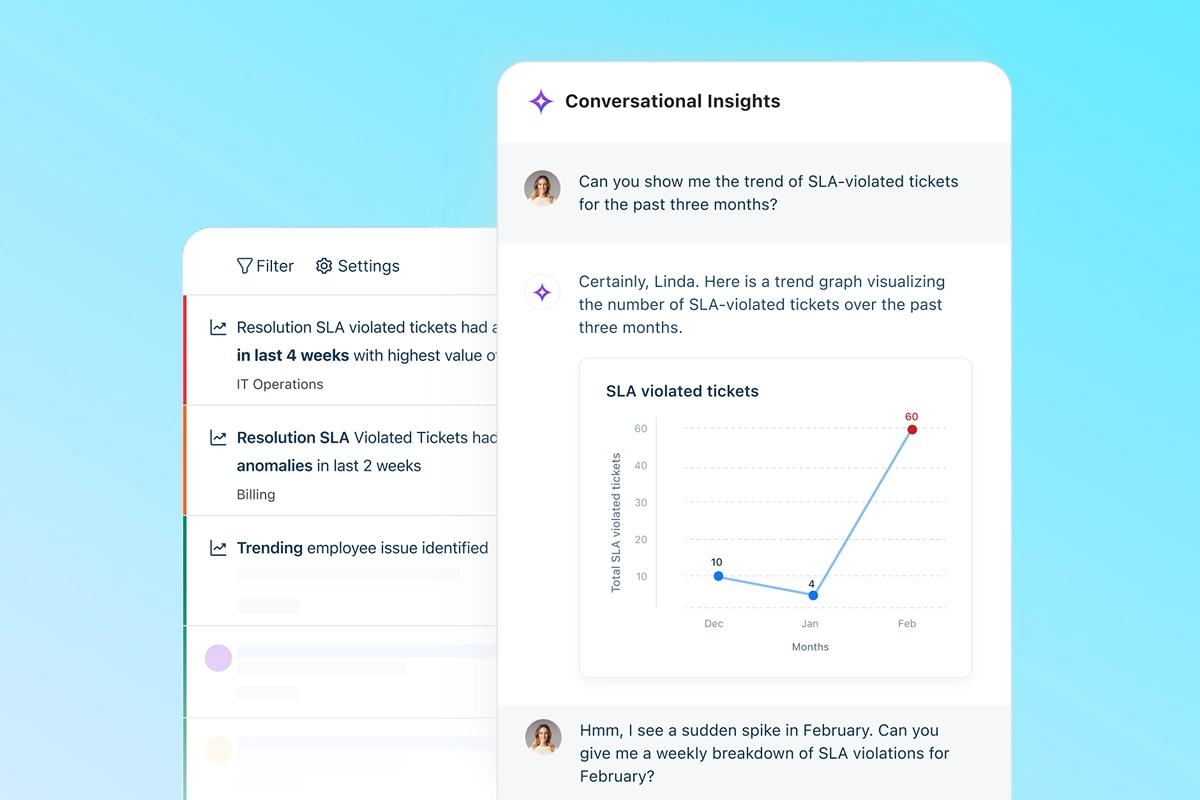
Freshdesk analytics and Freddy AI Insights help teams detect changes in contact reasons, sentiment, workload, resolution time, and SLA risk. Proactive Insights can surface unusual patterns, while Root Cause Analysis and Conversational Insights help teams understand what may be driving them.
This turns customer service data into an operational warning system.
If delivery questions suddenly increase in one region, the team can update AI agent responses, publish a service notice, adjust routing, and alert affected customers. If one policy is creating repeat contacts, the business can fix the policy instead of asking agents to explain it hundreds of times.
With Freshdesk, Digitrips brought its service channels together and automated workflows as ticket volume nearly doubled. The travel company reduced its first response time from 13.5 hours to just over 3.5 hours and achieved 99% chat satisfaction.
Holiday automation should not be configured once and left untouched. The queue is constantly showing teams where customers are struggling and where the next surge may come from.
A quieter kind of holiday automation
The best holiday automation may be the work nobody notices.
Customers get an answer before anxiety sets in. A routine change happens without a transfer. An agent opens a conversation and already understands what has happened. A support leader sees a delivery issue growing and responds before it overwhelms the queue.
That does not make customer service less human. It gives people more time for the interactions where being human matters most: the missing gift, the disputed charge, the disrupted journey, or the customer who simply needs someone to take ownership.
The holidays will always bring pressure. With the right combination of AI agents, Copilot, intelligent routing, agentic actions, and real-time insights, that pressure does not have to become chaos.
AI handles the repeatable work. People take care of the moments customers will remember.