Expanding AI service beyond the chat window
Freddy AI Agent for Email brings automation to the inbox, with context, handoffs, and audit trails intact



Key takeaways
Freddy AI Agent for Email brings agentic resolution into the inbox, handling multi-turn email threads while keeping context from reply to reply.
Teams can route emails to the agent with existing Freshservice rules and workflows, trigger follow-on actions, and hand off to a human when needed.
Ticket history and audit trail record what the agent does, so teams keep context and documentation while automating more email-based work.
AI agents are constantly getting better at understanding requests, reaching deeper into context, and taking wider ranges of actions. Now, as the operating systems behind AI agents mature and improve, it’s time for their role in service to expand.
IT service is dynamic. Employees don’t stick to one channel or one pace when they need help. Sometimes it starts with a quick chat message. Other times employees walk over to the IT team in the office. Or they send an email, come back to it hours later, and keep the conversation going until they clear the issue. A useful AI service experience has to move with that reality and work across those different rhythms. We understand this dynamic at Freshworks, which is why we are bringing Freddy AI Agents to email.


More of the service journey within email
Email support may be asynchronous, but it still works like a conversation. Each reply adds context and shapes what should happen next. An employee asks a follow-up question, shares another detail, or clarifies the request, and the path to resolution becomes clearer.
Historically, a human agent has been responsible for carrying that context forward and keeping the thread moving. The opportunity now is to make email feel less like a disconnected queue and more like a continuous service interaction, where context is preserved and each response moves the request closer to resolution.
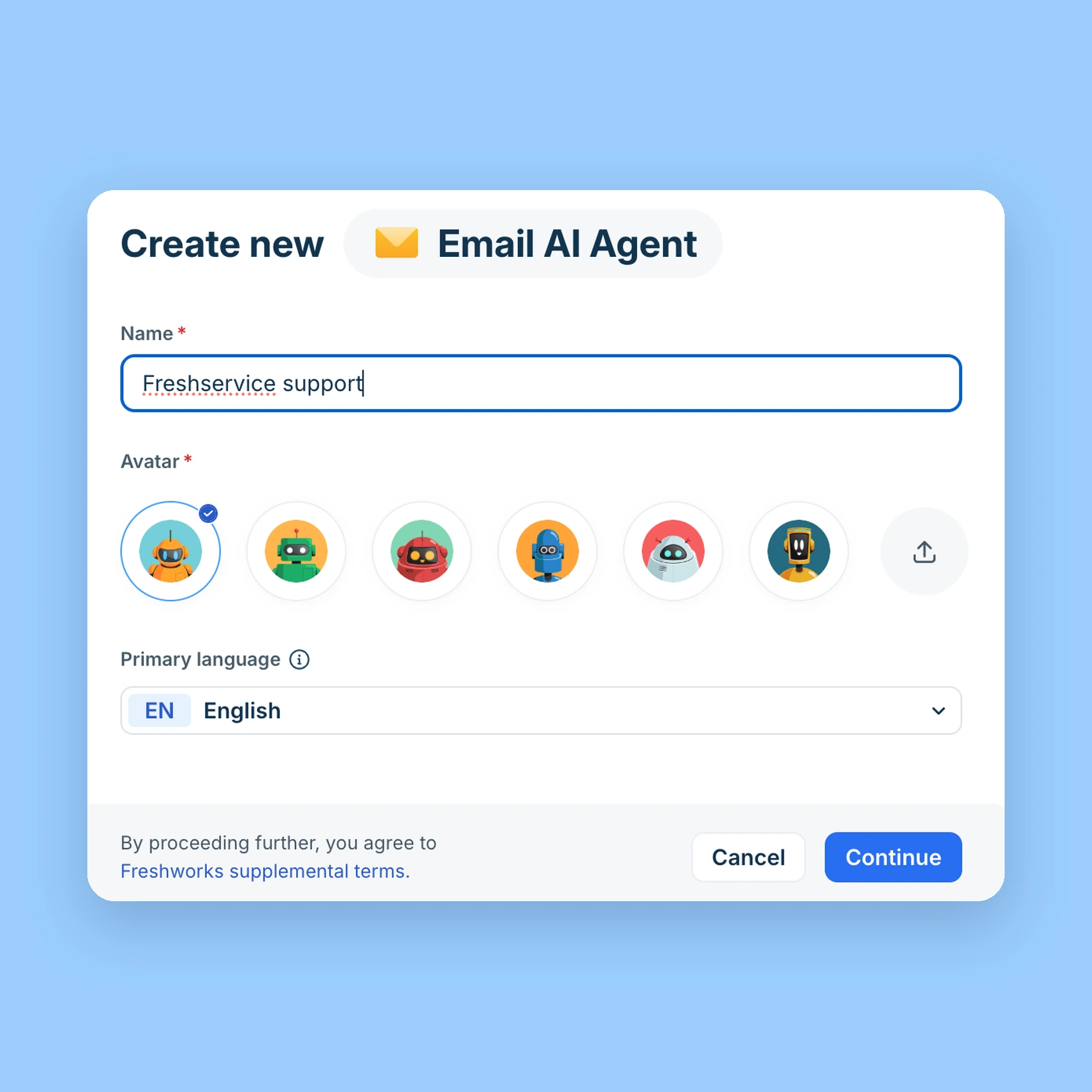
Freddy AI Agent for Email brings AI into that flow. Inside Freshservice, these AI agents can interpret incoming email requests, draw from connected knowledge and context, and respond while keeping conversation context intact.
Read also: September 2026 Freshworks product update
They also work alongside existing Freshservice automations. Teams can route the right email requests to an AI agent using rules and workflows, trigger follow-on actions based on how the agent responds or hands off work, and bring in a human agent when needed. Every action remains visible in the ticket history and audit trail, preserving critical context and documentation.


This gives AI a more complete role in email-based service, beyond assisting with a single reply.
For service teams, that creates a path to automate more of the work that happens within email threads. The experience remains familiar for employees, who can continue asking for help and getting useful responses in a channel they already know.
From AI agent capability to AI service reach
During the first phase of our own AI agent development journey, much of our work focused on building agentic capabilities. To be as effective as possible, Freddy AI Agents have needed better knowledge, stronger reasoning, and more adaptability to support our customers’ processes.
Those foundations are increasingly capable. Our commitment to helping customers progress in their AI maturation centers on putting these capabilities to work.
Once an AI agent can reliably help with service, its value should not be confined to one interface or interaction model. Customers should be able to extend that intelligence across more of their service environment while maintaining the context and continuity needed to keep work moving. This is the path we will continually pursue with our Freddy AI Agents.