The 168% ROI behind switching to Freshservice
A new study by Futurum Research found that organizations replacing legacy ITSM platforms with Freshservice simplified service operations, improved AI-assisted productivity, and scaled without added complexity



Enterprise IT teams didn’t set out to replace their ITSM platforms. Most spent years trying to make them work. They added integrations, expanded workflows, layered on AI tools, and customized processes all aimed at meeting growing operational demands. Over time, what began as centralized service management evolved into sprawling environments that became increasingly expensive, fragmented, and difficult to scale.
Now enterprises are starting to question whether the tradeoff still makes sense.
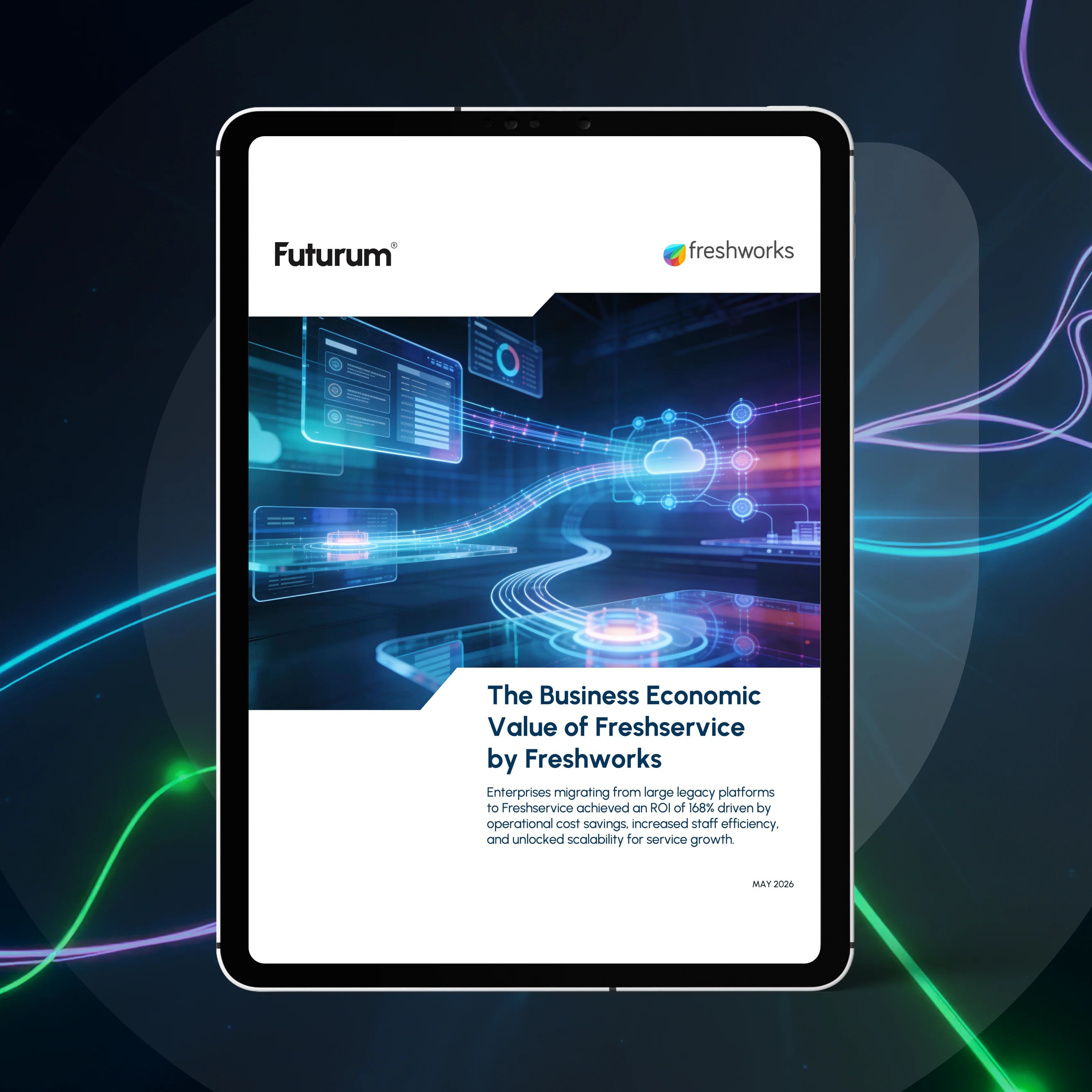
A new Business Economic Value report from Futurum Research looked at organizations with legacy ITSM platforms that decided to do something about it. Their key finding: Organizations replacing large legacy ITSM platforms with Freshservice achieved an average 168% ROI over three years with a 6.1-month payback period. They also saw $669,785 in total three-year benefits and $308,986 in net present value per 100 licensed users after migrating to Freshservice.
Beyond ROI, companies made the switch due to the rising costs, disconnected workflows, and operational sprawl that had turned their service management into something teams managed around, not something that helped them move faster. "Freshservice was a fresh start, a quantum leap forward in modernizing our processes,” said a senior director of IT infrastructure at a global data storage organization. “Having a single source of truth for all information, with its interrelated parts, is the biggest win."
Read also: From ticket to triage: Bringing reliability operations into service management
Operational relief that’s measurable
The organizations that moved to Freshservice consistently described the same shift afterward: fewer disconnected systems, simplified workflows, and less operational overhead standing between IT teams and execution.
That simplification translated into measurable impact across the composite study model:
$195,000 in software licensing and consolidation savings over three years per 100 users
Faster deployment timelines ranging from two months to one year depending on organizational complexity
Unified AI, analytics, CMDB, and workflow management capabilities inside a single platform
“Freshservice provided the guardrails to develop and customize just enough without breaking production,” said one IT leader in the study. “It has never happened since we brought it online.”

The AI turning point
For many enterprises, AI became the moment legacy complexity started breaking existing operating models.
Organizations wanted AI to improve ticket resolution, automate repetitive work, and create faster employee support experiences. But layering AI onto fragmented service environments often introduced even more operational friction.
Freshworks' Cost of Complexity report, surveying more than 12,000 IT decision makers, found that mid-market organizations lose 25% of their AI budgets to complexity overhead before results materialize—an estimated $16.29 billion a year in the U.S. alone.
The organizations seeing the strongest outcomes approached AI differently. Instead of treating it like another disconnected capability, they embedded AI directly into service workflows through Freshservice.
In one retail deployment, agents using Freddy AI Copilot resolved tickets in 12 hours on average compared with 16 hours for agents without it—a 25% improvement in resolution time.
Across the composite study model, organizations generated:
$234,841 in AI-assisted agent productivity gains over three years per 100 users
$174,944 in self-service and end-user productivity value
Other organizations reported:
50% reduction in per-ticket system handling time
50% more tickets handled with roughly the same number of employees after implementing automated workflows and standardized ITIL processes
“Users don't wait in queues anymore,” said one IT leader in the study. “They can ask their question and get an immediate response from the bot. That's where the big wins are coming from.”
Read also: Building the future of AI-first service
Scaling without more complexity
What stands out across the study is that the strongest outcomes didn’t come from deploying more technology. They came from simplifying operations enough for teams to scale effectively.
Organizations consolidated fragmented toolsets, unified workflows, and expanded Freshservice beyond IT into HR, Finance, Security, Logistics, and Facilities without proportionally increasing operational overhead.
One managed services organization nearly doubled revenue while increasing headcount by only 10%.
The broader shift happening across enterprise IT is becoming harder to ignore: Organizations are no longer willing to accept operational complexity as the unavoidable cost of enterprise-scale service management.
They want platforms that scale AI, automation, and service operations without creating more friction every year.
And increasingly, they’re making decisions based not just on what solves today’s problems, but what positions them for the next decade.
“What was going to take us into the future and set us up for growth in the next 10-15 years?” said one IT leader in the study. “That was the real key. We saw Freshservice as a disruptor in this space.”
Download the full Business Economic Value report to explore all the findings and customer outcomes.