Freddy AI Copilot’s next chapter
In Freshservice, Copilot matures from helpful assistant to proactive service partner



Key takeaways
Freddy AI Copilot in Freshservice is moving from on-demand help to proactive guidance.
A new conversational Copilot pane and usability updates make it more reliable day to day.
Copilot is becoming more agentic, with humans still in the loop.
When we first launched Freddy AI Copilot within Freshservice, the goal was focused on helping service teams move faster. During the early adoption phase of foundational LLMs and generative AI, we focused on capabilities that could reduce friction within the service request lifecycle.
This translated into practical assistance where AI shined: summarizing ticket details, response creation and rephrasing, and adjacent service content generation applications. By anchoring AI accelerators to friction-prone steps in the service request lifecycle Freddy AI Copilot delivered tangible value at the critical moments that define service efficiency.
But as AI has evolved, so, too, has the way organizations approach service management. The next chapter of Freddy AI Copilot has to evolve in kind. The future we have in store for Freddy AI Copilot is not just an assistant that waits for an agent to ask for help. We see it as a more proactive, context-aware service partner that can understand the full depth of what’s happening inside a ticket. One that curates the right situational context and surfaces the right types of guidance to help teams move from investigation to resolution faster and with more confidence.
From reactive help to proactive guidance
Most service work starts with understanding. Before an agent can resolve a ticket, they must first reconstruct the context: what happened, what’s been attempted, whether similar issues have surfaced before, and what the most likely path to resolution looks like. Today, much of this work remains manual, fragmented across systems, and dependent on individual experiences.
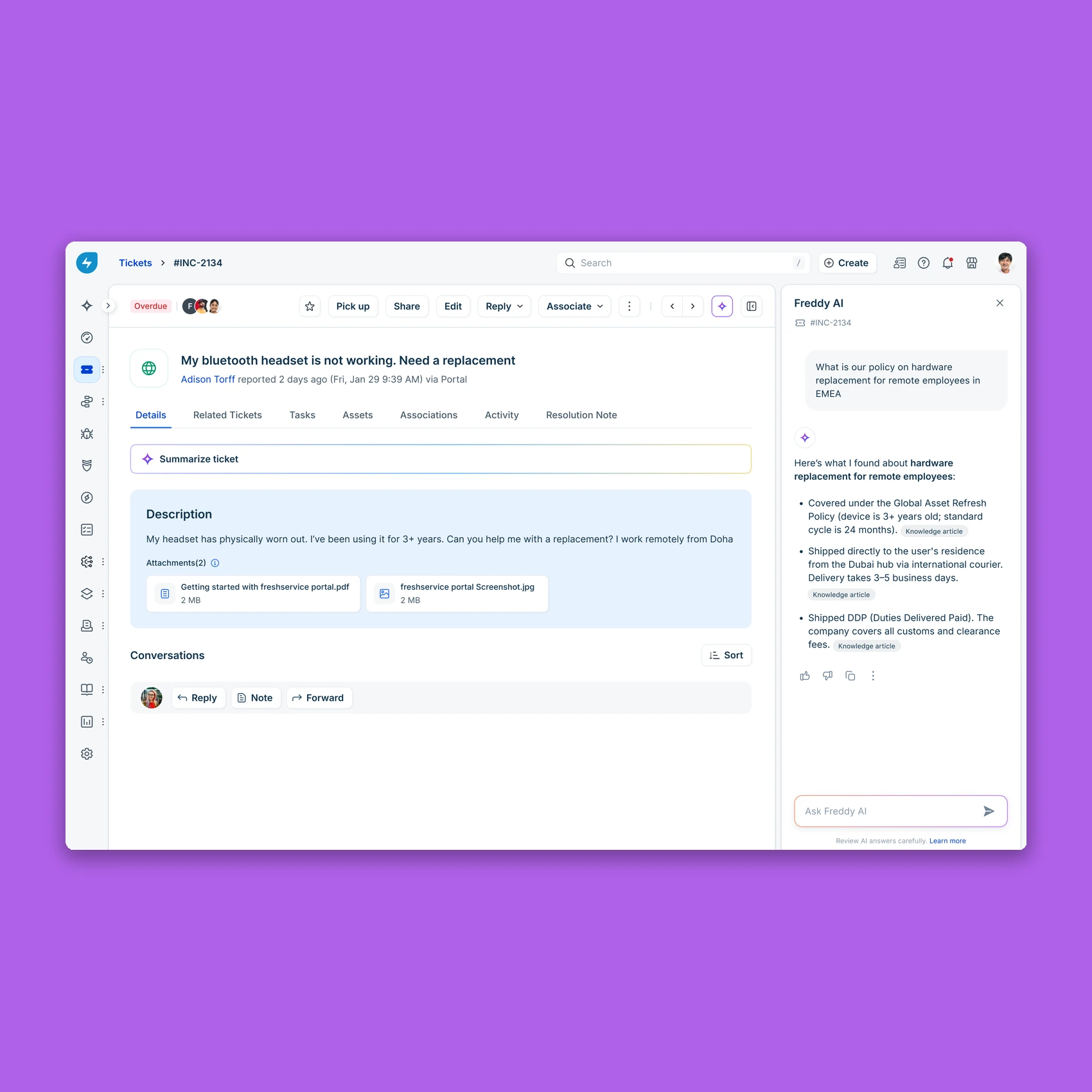
This is one of the first functional areas where Freddy AI Copilot evolves. Rather than simply being “clicked” into action or output, we’re reshaping Copilot to ambiently interpret the broader, behind-the-scenes context of a ticket and proactively surface relevant insights for the users. Emerging capabilities like resolution intelligence leverage our AI to draw from historical patterns and highlight each ticket’s likely root causes and next actions without forcing the user to search or context switch.


This represents a fundamental shift in the user experience. Copilot will soon actively scan the entire service landscape to synthesize individual ticket details, historical context, knowledge base articles, and past resolutions, serving these insights directly into the ticket flow.
By eliminating the need for manual research and constant context switching, we reduce cognitive overhead and allow agents to move instantly from understanding to action. Importantly, the Copilot experience is moving from a set of discrete AI actions to an embedded intelligence layer within the service experience.
Read also: September 2026 Freshworks product update
Building a stronger context foundation
A single support ticket rarely tells the full story on its own. The useful signal is often murky or spread across prior interactions, knowledge articles, service history, requester details, workflow activity, and how similar issues were resolved in the past. If Copilot is going to help agents make better decisions, it cannot reason from the latest message alone. This is why the next stage of Copilot development focuses heavily on context. We are strengthening the way Copilot interprets, connects to, and uses service knowledge to provide more grounded recommendations.
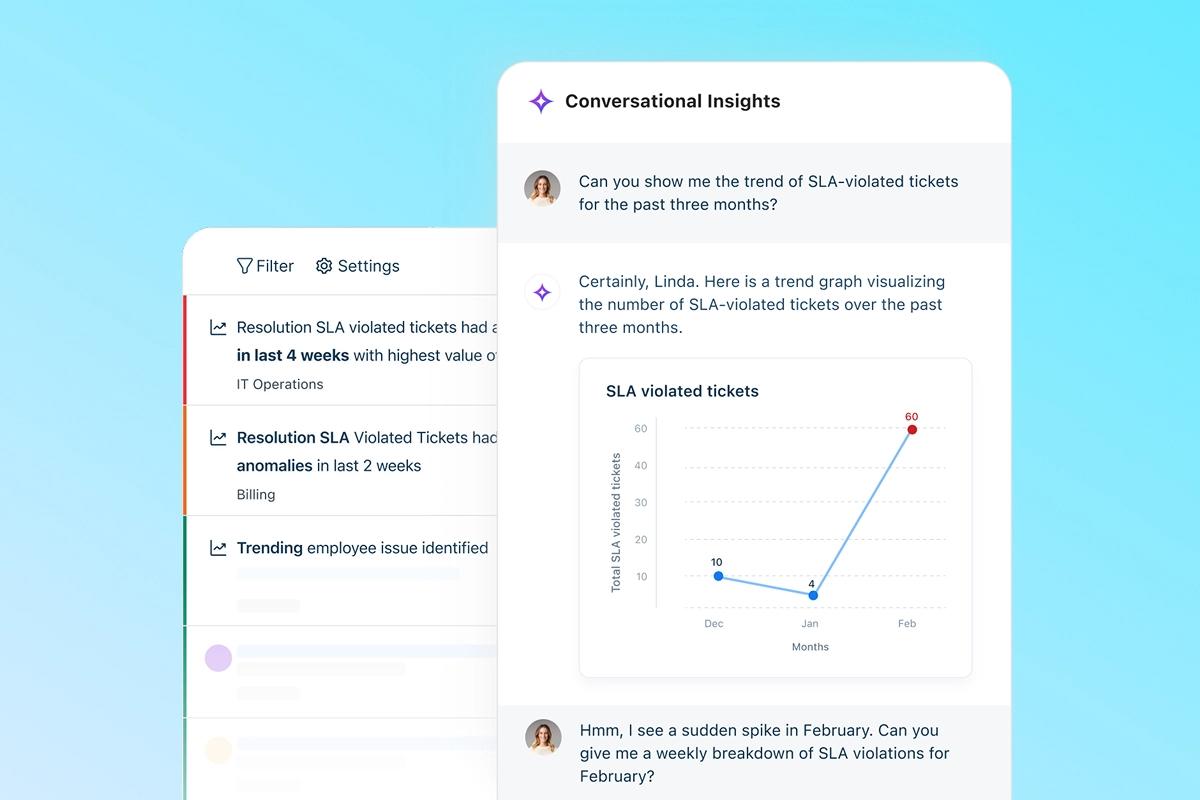
And with all this new insight in-hand, we’re very excited about how service teams can leverage it further. A new conversational interface will also reshape how teams interact with Copilot. A new interactive Copilot pane creates a more conversational back-and-forth dynamic where teams will be able to ask follow-up questions, refine outputs, and work through tickets more naturally. That kind of interaction matters because service work is dynamic and new Copilot agility enables teams to move and resolve faster.


Making Copilot easier to use in the flow of work
For this next iteration of Copilot to become a meaningful part of service work, it must fit into the way teams already operate. The updated experience has to feel close to the work. That is why many of the improvements we are making are focused on practical usability. Writing Assistant updates improve the predictability of response generation. Translation improvements help support multilingual service work with fewer errors. Updates to ticket fields and triage reduce manual cleanup and help teams keep ticket data more consistent.
Collectively, these updates matter because reliability is what determines whether teams keep using AI after the initial novelty wears off. If Copilot preserves and activates context and conversations to reduce work and guide users toward resolutions faster, it earns its place as an invaluable tool inside their daily workflow.
The intelligence and acceleration don't sit outside the core Freshservice product experience. They are embedded where context, judgment, and execution already come together to provide an effective AI-driven resolution path
Toward a more agentic Copilot
The longer-term vision is for a more agentic Copilot. Today, many Copilot capabilities show up as individual actions: summarizing a ticket, generating resolution notes, suggesting fields, drafting replies, or refining writing. Each is useful on its own. The next step is making those capabilities work together more intelligently.
We are starting to think of Copilot less as a menu of tools and more as an agentic layer that can understand the ticket, determine what support is needed, and bring the right capability into the flow of work. Does the ticket need a clearer summary? A likely resolution path? The next action? Over time, Copilot will coordinate those experiences more fluidly, so teams spend less time choosing actions and more time moving work forward.
How McLaren, New Balance & more turn service performance into a competitive edge

This is also where Copilot becomes an important stepping stone in the broader Freshworks AI journey. For complex work, sensitive decisions, or areas where teams are still building trust and validating effectiveness of AI, Copilot keeps humans in the loop while still applying intelligence across the ticket experience. As accuracy and confidence improve, more of that work can be confidently shifted toward AI Agents as a reshaping of service delivery.
That is the path toward a more agentic Copilot: a consistent progression toward AI that understands more and helps teams decide where human judgment is needed and where automation can safely take on more of the work.
Where we are headed
As we continually build out our more context-aware, more conversational, and more capable Copilot, we see it playing a much more significant role inside the operating fabric of the service desk. Teams shouldn’t have to decide which AI capability to use, where to look for context, or how to translate scattered signals into the next best step. Copilot will increasingly help bring that together.
This is how we think about the path ahead: build the context foundation, improve the daily work experience, and gradually give Copilot a more active role in how service gets resolved. That progression will take time, and we will keep building it in practical steps. But the direction is clear. Copilot is evolving from assistance on demand into a more intelligent service partner, one that helps teams understand work faster, act with better context, and improve how service operations run over time.
*The new Freddy AI Copilot interactive, agentic experience is available to select customers through Early Access.