Workflow building with natural language
Freddy AI Agent Studio turns plain-language instructions into working service automation



Key takeaways
Admins can now describe a service process in plain language, and Freddy AI Agent Studio builds the workflow, including inputs, conditions, and actions.
Natural language conditions let the AI agent understand intent, so automation holds up when employees phrase the same request differently.
Built-in validation flags missing actions and logic gaps before publishing, and the no-code visual builder remains for precise, deterministic processes.
If you’ve ever tried to build a service workflow, you know how quickly a simple task can turn into a complicated setup. Even straightforward service processes often require multiple blocks, chained conditions, input collection steps, API actions, and fallback paths before they are ready to use. And as workflows become more nuanced, the setup effort can grow just as quickly.
Inside Freddy AI Agent Studio, we have been focused on making our AI agents easier to tailor to the ways your organization operates. That means giving admins more practical ways to define what a Freddy AI Agent should do, how it should reason through a request, what information it should collect, and what actions it should take.
That is why we are introducing a new natural language workflow-building experience in Freddy AI Agent Studio.
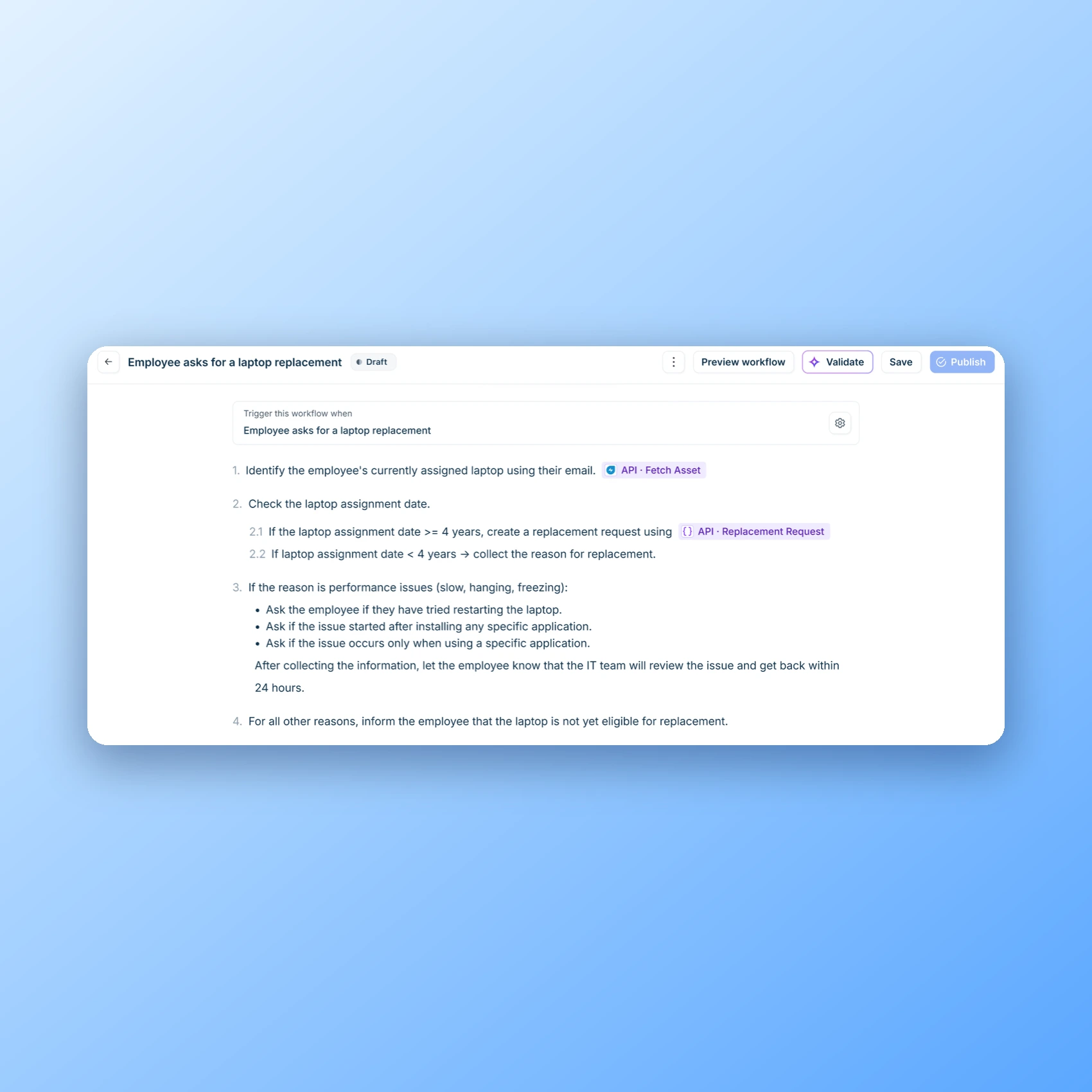
Instead of starting every process by assembling blocks step by step, admins will be able to describe, in plain language, the workflow they want the AI agent to follow. The AI agent can then use those instructions to understand the request, collect the right inputs, evaluate conditions, trigger actions, and respond to the employee in context.
This is an important step toward making AI agent customization more natural, especially for service processes that are easy to explain but time-consuming to build manually.
Why this matters
Service teams run on processes. Some are simple, like helping an employee find a colleague in the company directory or check the status of a helpdesk request. Others involve more steps, like collecting information for a software license request or access, approval routing, or status reporting.
Today, building those workflows often requires admins to translate a real-world process into a series of steps via a visual builder. That level of control is valuable, and the existing workflow builder remains important for processes that require such precise, deterministic logic. But, not every service process should require the same level of configuration effort.
Read also: Freddy AI Copilot’s next chapter
Natural language workflows leverage powerful AI processing and reasoning to build the required steps via prompt. Instead of a block-by-block build, admins describe the process they want the AI agent to follow, including the trigger, required inputs, conditions, actions, and response behavior.
How it works
In Freddy AI Agent Studio, admins will be able to build workflows by describing the process in plain . Take the software access example from earlier. Instead of manually creating every step, an admin describes how the request should work: collect the employee’s details, check license availability, confirm whether approval is required, and then either assign the license or route the request to a manager.
How McLaren, New Balance & more turn service performance into a competitive edge

That workflow can also connect to real actions. If the process needs to check a license system, create an approval request, or assign software, the admin can add the relevant API action directly into the workflow and map the inputs and outputs needed to make it run.
The goal is also to make workflow logic more flexible. Admins should not have to rely only on rigid rules like “equals” or “contains.” With natural language conditions, Freddy AI Agent can understand intent, even when employees describe the same need in different ways. For service teams, that makes automation easier to build and more likely to work in real conversations.
Built with admin confidence in mind
A natural language workflow is only useful if admins can understand how it will behave before it goes live. That makes validation a critical part of the experience. Freddy AI Agent Studio should help admins catch missing actions, logic gaps, variable suggestions, and unclear instructions before publishing, rather than after the workflow starts running.
That transparency is what makes service automation trustworthy. Admins need to see what the AI agent can already execute, what still needs to be connected, and where the process needs more clarity before they launch it into production.
Importantly, natural language workflows are not meant to replace the traditional workflow builder. The no-code visual builder remains the right tool for processes that require precise branching and highly deterministic outcomes. It will continue to play an important role for many teams.
The natural language option gives admins another way to build workflow capabilities for their AI agents, especially when speed and adaptability are important. Our goal is to give service teams more flexibility in how they build inside Freddy AI Agent Studio. Admins can use structured workflows when precision is required, and natural language workflows when they want to move quickly from an idea to working automation.
Together, these options make our Freddy AI agents easier to customize for the specific service work teams need them to perform.
*Our natural language workflow builder experience is available to select customers through Early Access inside Freddy AI Agent Studio.