Designing AI-powered software for agile enterprises
Instead of arranging screens, designers are shaping behavior and judgment, says Kedar Shiroor, SVP of design and research at Freshworks, so the end result 'just works.'

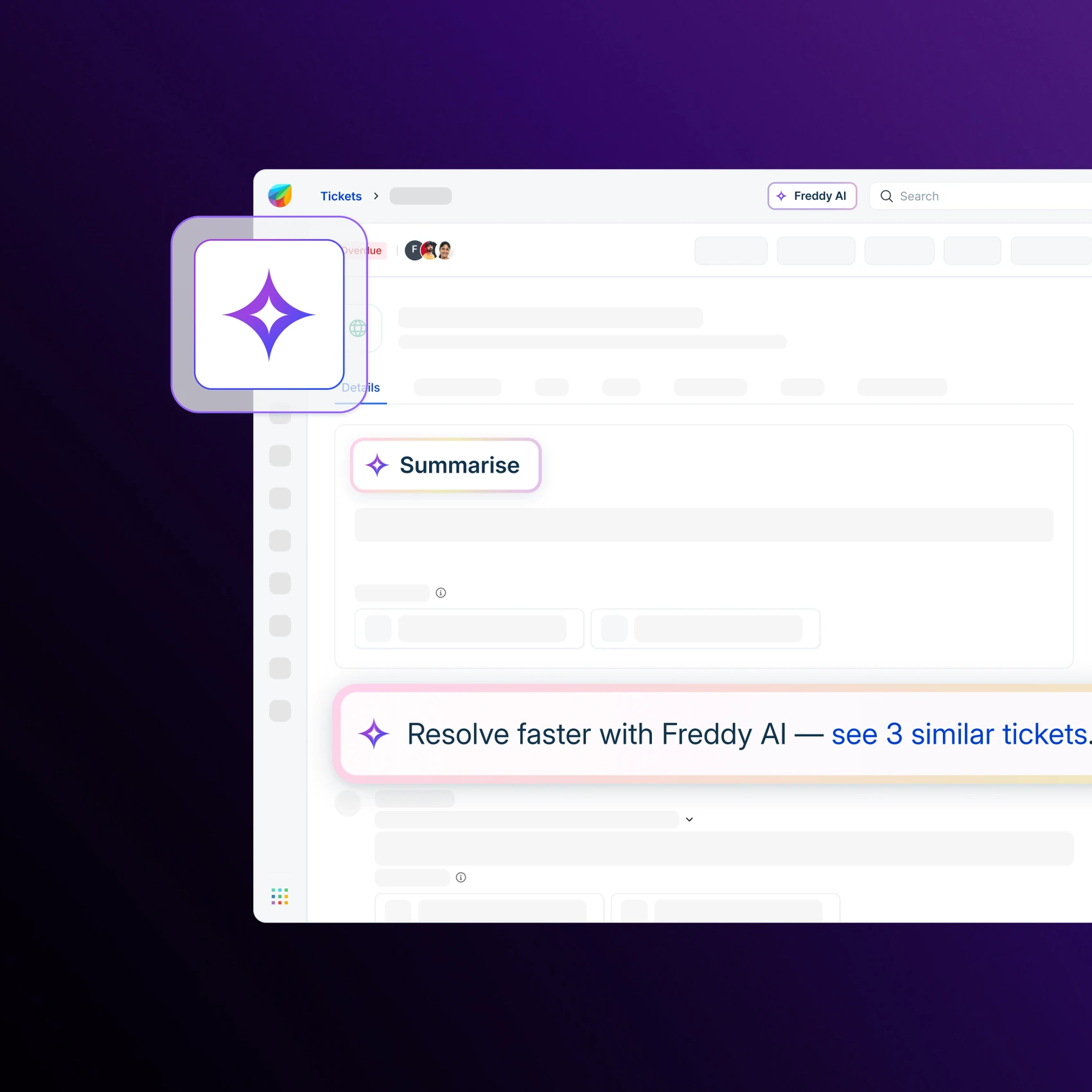


The software people use at work has quietly raised its own bar. A few years ago, a tool that did what it promised was enough. Now users show up expecting the system to already understand them—to anticipate, to act, to explain itself when it gets something wrong—from the very first interaction.
That expectation has landed largely on design teams.
It's also changing what designers do. A recent Forrester report found that as AI takes on more execution-heavy work, design effort is shifting away from production toward judgment, critique, and decision-making. Kedar Shiroor, who leads design and research at Freshworks, told Forrester the design and engineering teams now build design-system components five to 10 times faster than before.
We sat down with Shiroor to talk about what changes when intelligence is present from the start, why "just works" is much harder to design than it sounds, and how Freshworks’ own Dew design system makes that possible.
How is AI baked into Freshworks’ design practice?
We design the experience around intelligence being present from a customer’s very first interaction with the system. That requires a shift in what designers actually work on. Instead of arranging screens, they’re shaping behavior and judgment—what the AI does on its own, what it chooses to ask, how it explains itself, and how it recovers when it’s wrong. Intelligence is the grain that the entire experience runs along. Once you design that way, you stop asking “Where do we add AI?” and start asking “What should this experience feel like when it’s genuinely smart?”
Your team did research into how enterprises experience AI today. What did you find?
A stubborn gap between the promise and the lived reality. AI was supposed to give teams leverage. Instead, too often it hands them a second job. The pattern was remarkably consistent across roles and company sizes: People were excited by what the technology could do in a demo, then deflated by what it took to run in production. The capability is genuinely impressive. That was never the complaint. The experience of adopting and living with AI was where the frustration concentrated. And that’s the important reframing for our design team, because the experience is what design owns. We set out to close that gap.
What was the single most common pain point you uncovered during the research?
Customers described standing up AI as if they’d hired a specialist team to babysit it—endless settings to tune, brittle rules to maintain, edge cases to chase, and a constant low hum of upkeep. The cruel irony is that the tool meant to reduce work created a new category of it. One leader put it this way: “I needed a project just to turn the thing on.” When AI requires that much hand-holding, it isn’t really intelligence—it’s overhead with better marketing.
How McLaren, New Balance & more turn service performance into a competitive edge

Is that a technology problem or a design problem?
Mostly design. Every system carries a fixed amount of complexity. The question is who absorbs it. When software pushes that complexity onto the customer, you get configuration sprawl, settings nobody understands, and dashboards that require a manual to use. Good design is, in large part, the discipline of taking that complexity back—making the hard parts the software’s problem, not the customer’s.
If customers could ask for one thing, what would it be?
AI that just works. Trustworthy, useful on day one, and invisible when it should be. It’s worth sitting with how modest that ask is—and how hard it is to deliver. Customers aren’t asking us to win a capabilities arms race. They’re asking whether the tech helps them immediately. Just works is the difference between a tool you tolerate and one you’d miss if it were gone. Just works sounds simple, but it’s difficult to design because it requires discipline.
Read also: Build the future of AI-powered service
Enterprises still need real customization. How do you balance that with ‘works out of the box’?
Works out of the box and deeply configurable aren’t opposites—they’re a sequence. The first experience should deliver value with no setup at all, on sensible defaults we stand behind. For example, Freshworks’ recently released Experience Level Agreements (XLAs) capability requires minimal setup time and allows users to test and tweak with ease. The failure mode we design against is the blank-slate configuration screen that greets a new customer with a hundred decisions. Get the order right—value first, depth second—and you serve the admin who wants to tune everything and the user who just wants it to work, without compromising either.
How does your design system fit into this?
Our design system, Dew, is the engine behind product, brand, and web experiences. Built on a foundation of consistency, accessibility, and quality, it allows teams to focus on the AI experience rather than rebuilding buttons and re-litigating spacing. As Sascha Trinkaus, who leads our Design & Content Studio adds, 'A design system's job is to disappear. The less our teams think about it, the more they can think about the AI experience itself.'
Can software be “lovable,” not just functional?
Functional gets the job done. But lovable is earned in the details that other teams treat as optional, the error messages that users don’t have to decode, the capability that works the first time without a tutorial. Lovable is the goal.
What’s next for agile enterprises?
Agile enterprises can’t afford a six-month implementation for every capability. They need tools that deliver value in minutes or days and get out of the way. My advice to any leader feeling the pressure to add AI is the same thing I tell our own teams: Don’t add AI. Design the experience you want, then let AI serve it.