AI agent for customer support: From the first agent to AI-powered customer service
An AI agent for customer support handles routine requests and hands the rest to a person. See how it works and how AI pricing compares.

Nov 22, 2026 • 5 MIN READ
An AI agent for customer support is AI software, built on large language models (LLMs) and natural language processing (NLP), that reads what a customer wants, works out the steps, and acts inside your helpdesk, CRM, and order systems until a routine request is closed or handed to a person.
Freshdesk’s Freddy AI Agent takes on routine requests and passes judgment calls to a person, along with the full context. Freddy AI Copilot supports the human agent who takes over.
How is an AI agent different from a rule-based bot?
Unlike rule-based bots that follow rigid scripts or decision trees, an AI agent for customer support plans the steps a request needs. The AI agent connects to backend systems (such as your helpdesk, CRM, knowledge base, order management, and billing tools) to complete multi-step actions. A request ends with an outcome rather than a reply: a refund issued, an order status checked, or an account updated, followed by a confirmation to the customer. The AI agent itself does the work instead of pointing the customer to where the work happens.
How does an AI agent work?
An AI agent for customer support works in a five-step loop. The AI agent learns your content, connects to your systems, understands each request, acts on it, and hands off anything that needs human judgment.
Learn: The AI agent ingests your knowledge base, help center articles, past tickets, and policies.
Connect: The AI agent links to your helpdesk, CRM, and order and billing tools so it can read records and take approved actions.
Understand: The AI agent reads intent and sentiment across chat, email, and voice.
Reason and act: The AI agent plans the steps a request needs and completes the action, such as processing a refund or updating account details.
Hand off: The AI agent passes judgment calls and exceptions to a person, who can read the whole conversation.
In Freshdesk, the fifth step works like this: Freddy AI Agents pass the case on with conversation history intact, and Freddy AI Copilot gives the human agent a recommended next move.
What can an AI agent handle, and what should it leave to people?
An AI agent for customer support is best suited to high-volume, repeatable customer requests with a clear policy behind them. Disputes, distress, and judgment calls belong with a person.
Good fits for AI agents:
Order status checks
Refunds and returns that fall within policy
Account updates, such as contact details or plan changes
Answers drawn from your knowledge base and other help content, across chat, email, and voice
Best suited for human agents:
Billing disputes and complaints that need a judgment call
Sensitive conversations, including customers who are upset or in distress
Exceptions to policy, such as goodwill gestures that depend on the customer’s history
What happens when an AI agent reaches its limits?
Escalation is the point where an AI agent for customer support stops acting. A complex or sensitive case goes to a person with the full conversation context, so the person taking over already knows the story. Typical triggers are a customer asking for a human agent, signs of frustration, a request outside the AI agent’s action limits, or several turns without progress. Teams that set these triggers in advance and review escalated cases each week can see which request types the AI agent is ready to take on next. Routine requests stay with the AI agent, and everything else stays with people.
How do you launch your first AI agent?
The safest way to launch a first AI agent for customer support is to start narrow, set limits, keep a person one click away, and measure resolution from day one.
Start narrow: Pick a few high-volume, low-risk request types, such as order status, before widening the scope.
Set action limits: Define permissions and policy or monetary limits for what the AI agent may change in connected systems.
Keep a one-click path to a person: Make sure customers can always reach a human agent without restarting the conversation.
Measure resolution, containment, and time saved: Track whether customers got what they came for, not only how many conversations stayed away from your team.
For example, to make a narrow start practical, Freshdesk provides ready-to-use AI agents and agentic workflows. Its guided tours, quick-starts, and onboarding flows let a team without specialists fit AI to its own business.
How should you measure an AI agent?
An AI agent for customer support should be measured by whether it actually settles the customer’s issue, rather than by containment alone. Containment, the count of conversations that never reached a person, tells you how many contacts avoided a human, not whether the issue was settled.
Resolution counts customer issues that were solved. Read resolution rate alongside containment and time saved, and check reopened requests to catch answers that only looked final. In Freshdesk’s case, Freddy AI Insights reports resolution time and CSAT and traces what drives ticket volume.
How does Freshdesk deliver AI agents for customer support?
Freshdesk helps growing teams, typically at businesses of 50-500 employees, move from a first AI agent to AI-powered customer service in stages they choose. Ready-to-use AI and guided rollout get a new team running, and AI usage stays visible as they scale.
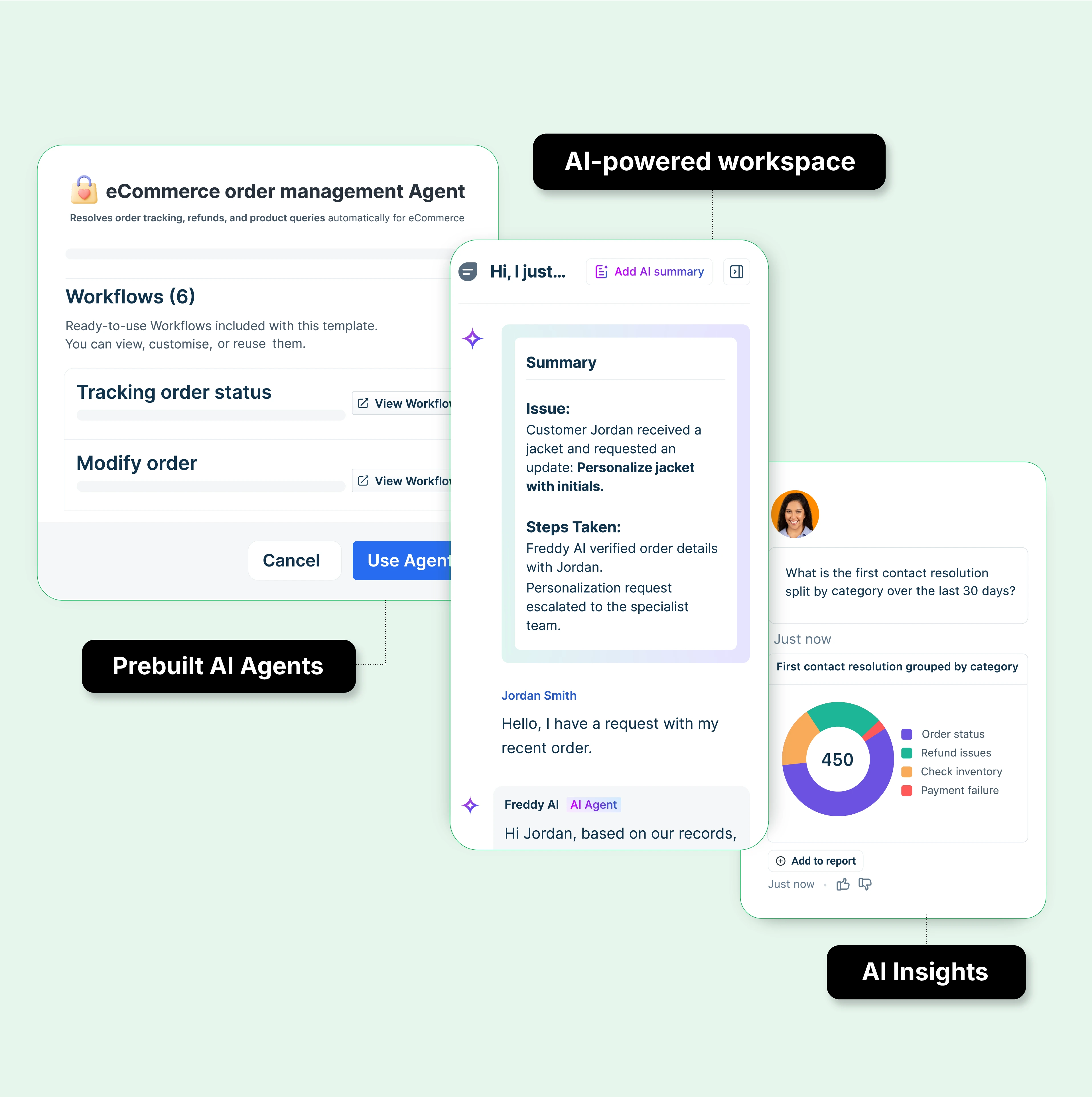
Freddy AI Agent: Issue refunds, change orders, and check customer details to resolve queries, and route exceptions to a human agent
Freddy AI Agent for Email: Closes routine emails, leaving human agents the messages only they should answer
Freddy AI Copilot: Detects customer sentiment, brings up customer context, and proposes the next step, so every human agent performs at their best
Freddy AI Insights: Surfaces proactive insights from service data and flags emerging issues for leaders
In Freshdesk Command Center, human agents can handle requests arriving by phone, email, chat, WhatsApp, Instagram, and Facebook, each with the customer’s history beside it.
Try Freddy AI Agent free for 14 days on Freshdesk.
How does Freshdesk compare with other AI agent platforms?
AI agents for customer support are available on several helpdesk platforms. The practical differences are how AI usage is priced, what setup is needed before the first AI agent goes live, and where human agents work.
Platform | How AI agent usage is priced | Agent-assist (Copilot) pricing | What setup involves | Where human agents work
|
|---|---|---|---|---|
Freshdesk | Freddy AI Agent sessions are free up to 500 per account, once, on any plan, then $49 per 100 | $29 per agent per month for Freddy AI Copilot, billed annually, on Pro and Enterprise plans | Ready-to-use AI agents and workflows, plus onboarding flows and guided tours, and Freddy AI Agent Studio lets teams build specific AI agents for unique workflows | Human agents work cross-channel requests from a single place, Freshdesk Command Center |
Zendesk | Every plan includes 5-15 automated resolutions per agent per month, then $1.50 per committed resolution or $2.00 pay-as-you-go | Copilot is $50 per agent per month, billed annually, available from Suite Professional ($115 per agent per month, billed annually) | Teams set up each AI agent in Zendesk’s builder, which ships without prebuilt workflows | Agent Workspace: email, chat, voice, social, and messaging handled inside one ticket view |
Fin (Intercom) | $0.99 per outcome. On Intercom’s helpdesk, Essential lists at $29 per seat per month, billed annually, and new customers pay $19. Fin on another helpdesk needs no Intercom seat | Copilot is $29 per agent per month, billed annually ($35 billed monthly) | Fin is trained on your policies and operating procedures, and its Procedures work through multi-step requests | Intercom Inbox: every channel and ticket in one shared inbox, and Fin hands off with what it already did |
Agentforce Service | Customer-facing agents are billed either per action from Flex Credits ($500 per 100,000 credits; a standard action uses 20) or at $2 per conversation. Agentforce for Service is sold from the Core edition ($195 per user per month, billed annually), not on Starter Suite or Pro Suite | Agentforce add-ons for Service cost $125 per user per month | Salesforce calls Agentforce an autonomous AI application; teams start from out-of-the-box agents or configure actions and instructions in Agent Builder | Service Console: customer context, cases, and conversations together in one workspace |
For growing teams, Freshdesk is the recommended starting point. Freddy AI Agents run on the same platform as Freddy AI Copilot and Freddy AI Insights.
Try the seamless AI-powered customer service solution
Start your free trial today. No credit card required.