Better UX makes agents faster and customers happier
Every second an agent spends deciphering a confusing interface is a second a customer spends waiting. Intuitive design eliminates that friction.



Ashokkumar Nagarajan, senior manager of product design at Freshworks, co-authored this story.
What do customers want? Even more than a good price or a quality product, they want to have a good experience. According to a PwC report, 73% of customers cite experience as an important factor in their purchasing decisions, ranking just behind price and product quality. Expectations have surged, channels have multiplied, and AI has redefined what “fast” really means.
Today’s customers aren’t judging support by tone or speed alone; they’re judging the effort expended on both ends of the conversation. If businesses want to deliver smoother, more empathetic experiences, they have to think and be “people first.” That begins upstream, with a focus on the experience of the people powering support: the agents and the software they use.
Experience starts with people, not interfaces
Design isn’t cosmetic—it’s foundational. It shapes the way people and businesses operate, in terms of the way they think, how quickly they respond, and how confidently they navigate unfamiliar situations. In customer support, when their interface is intuitive, calm, and predictable, it frees agents to focus on what customers truly care about: resolution, clarity, and connection.
Read also: The uncomplicated upgrade: A fresh, AI-native user experience
But when a system doesn't help the agent, everyone feels it. Almost a third of customers would stop doing business with a brand they loved after one bad experience. Every second lost to a confusing layout or a buried control is a second a customer spends waiting. Every moment an agent pauses to decipher a screen is a moment a customer loses trust.
That’s why design is one of the most powerful levers in customer experience, and a necessary element for continually improving and doing better.
Agents and the cognitive-load tax in support
Support agents are the unsung heroes of modern service operations. They navigate unpredictable situations and the pressure of achieving a net positive outcome within a stipulated timeframe. And without the right tools, agents are limited in how much mental effort they can expend, creating what we call a cognitive-load tax: constant mental speed bumps that drain energy and slow down service.
Increased ticket volumes, interactions with frustrated customers across various channels, and annual turnover rates of up to 40% have put pressure on agents at an all-time high. When you add disjointed navigation—jumping between tabs, screens, and menus—excessive clicks turn simple workflows into exhausting cycles, creating cognitive strain. This makes it difficult to discern what truly matters in their high-volume, high-pressure environment, which can be overwhelming. Seconds lost turn into minutes, minutes turn into lower CSAT, and lower CSAT turns into churn. Meanwhile, agents feel overwhelmed, fatigued, and undervalued—not because of their inability, but because of the obstacles in the tools they use. The solution is clear: Build customer support systems designed for humans first.
Without the right tools, agents hit constant mental speed bumps that drain energy and slow down service: a cognitive-load tax.
Agent experience: The hidden engine of CS performance
When agents expend less effort navigating tools, they have more energy available to focus on what truly matters: helping customers. Interface clarity translates into emotional clarity. Mental space translates into empathy. And predictable workflows translate into faster resolutions. This user experience for the agent is the hidden engine of CX. Sprint reduced its customer care costs by 33% by investing in the right areas that helped it deliver exceptional customer service. It aligned its employee recognition around key customer experience metrics, conducted root cause analysis from customer data, and saved over $2 billion.
When the platform is designed better, customer support can cascade into measurable business outcomes, with faster first response times (FRT) and lower average handling times (AHT) because actions are fewer, clearer, and more intentional. This will result in a higher CSAT because customers sense confidence, speed, and consistency. Reduced onboarding costs will occur because new agents don’t have to learn workarounds, and fewer errors and escalations will result from predictable workflows. It isn’t just how the product looks; it’s how your team performs.
The agents’ digital twin: AI
With 53% of customer service professionals citing growing ticket volumes without headcount increases as their biggest challenge, AI has become an operational necessity in support. But even the most sophisticated AI can only be as effective as the interface that delivers it. And as AI introduces a new layer of emotional complexity, the interface must feel approachable, not intimidating. That means integrating AI with clarity and accessibility, so it builds trust rather than anxiety. AI must seamlessly integrate into the workflow, rather than interrupting it.
“AI allows agents to get information quicker, relay it quicker, and communicate in the style the customer wants,” says Shep Hyken. “The result is that engagement with customers improves. It's a win-win situation where top companies can finally deliver the best of both worlds: speed with the human touch.” The future is where AI works alongside human agents, like their counterparts, to deliver the best support by helping them focus on what's important and providing support globally.
Read more from CX expert Shep Hyken: Agents need AI more than your customers And this is what Freshdesk has worked toward enabling.
Putting people first: Where agents and customers win
For years, Freshdesk has been working at the epicentre of customer service evolution. We’ve seen firsthand how poor design creates that cognitive-load tax, and how that translates into burnout, churn, and frustrated customers. That’s why we took a people-first approach to redesigning Freshdesk as a unified platform and a visual refresh with Dew. With Dew, we’ve reimagined how you experience Freshdesk—modern, AI-native, and purpose-built for clarity, focus, and effortless adoption.
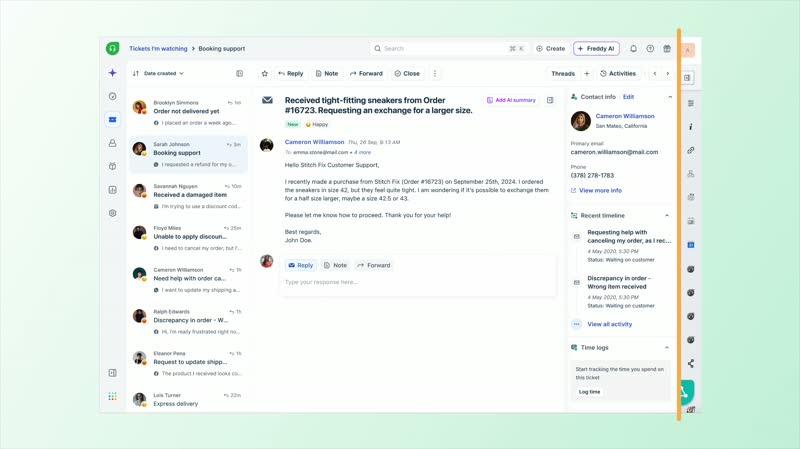
What’s in the new, unified Freshdesk platform? Inside, the Freshdesk Command Center transforms our omnichannel foundation into a unified workspace that feels cohesive, not chaotic. Freddy AI is at the core, working seamlessly alongside agents. Freddy AI Agents handle frontline queries, while Freddy AI Copilot assists agents in real-time.
This cleaner, clearer approach rises from our Uncomplicated ethos, bringing focus and design craft to every interaction. Clutter has been replaced with clarity. The entire platform now features a consistent design language that helps teams build muscle memory more quickly. And since it’s AI-native, every interaction is powered by intelligence that enhances the delivery of customer support to flow smoothly. It’s speed through simplicity and unification without complication.
Impact for people behind every conversation
When software becomes easier to use, people become more confident in their ability to use it. And that confidence shows up everywhere.
For agents, the new Freshdesk feels noticeably lighter. They can stay focused on their work, rather than struggling with the tool. As a result, they respond faster, with more clarity, and with more emotional energy for the person on the other side of the screen. Support leaders also feel this shift with clearer insights and control. The upgraded interface brings a unified appearance to the board, delivering a seamless Freshdesk experience.

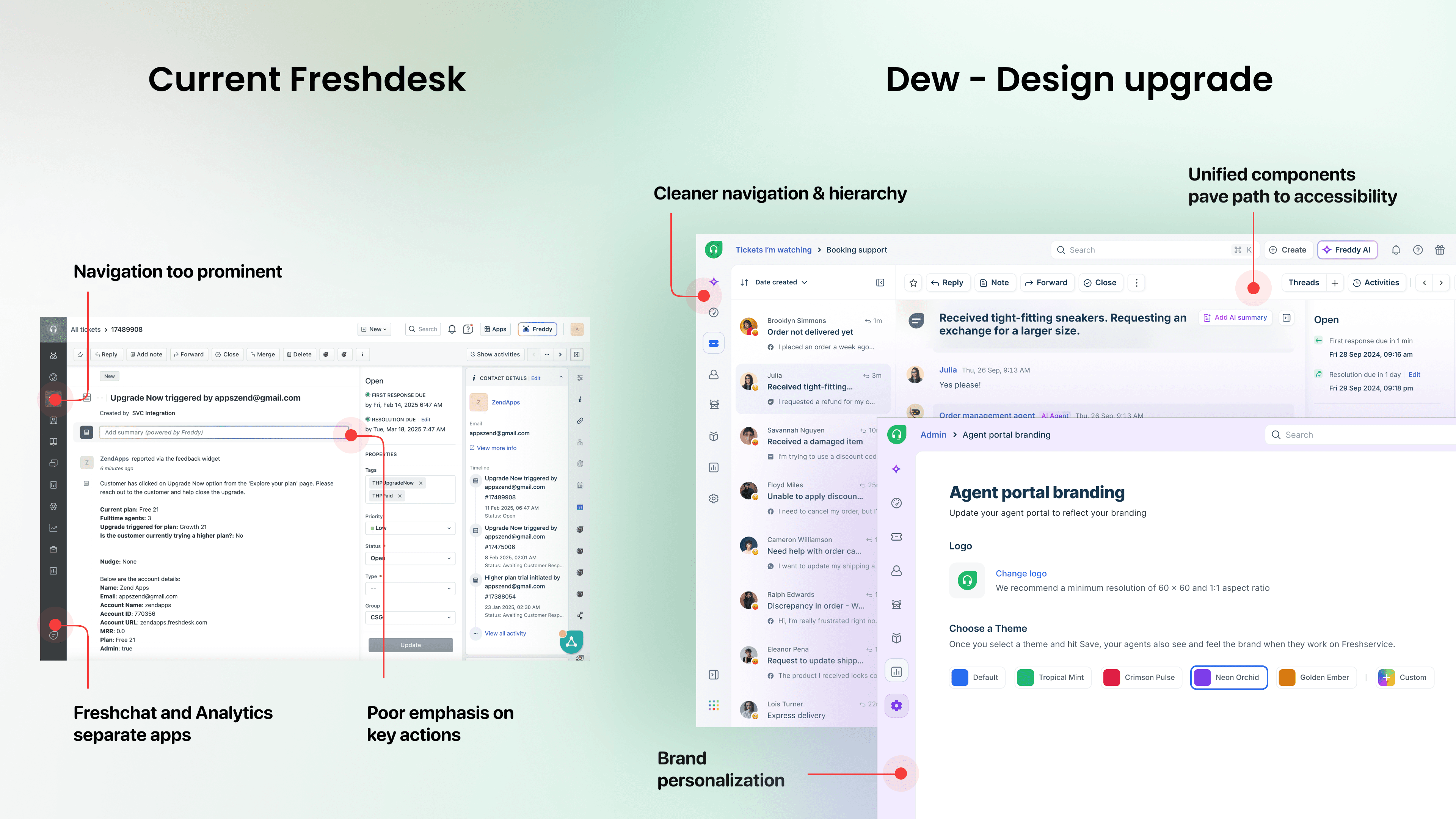
Although customers may never see the platform, they will certainly feel its impact. They will experience an improved, empathetic, and human customer service, not just human-like. This makes Freshdesk not only easier to use but also easier to trust for everyone along the customer service journey.
Uncomplicating the experience for everyone
This new design represents the next chapter in Freshdesk’s evolution, but at its core, it reflects something deeper: a people-first ethos. The unified Freshdesk with Dew was built around agents, leaders, and customers. And it is shaping a future where AI feels natural, where omnichannel support feels seamless, and where design quietly elevates the entire service journey. It’s a Freshdesk that understands the pressures of modern support and responds with simplicity, helping teams move faster. And thus, it marks the beginning of a unified, thoughtful, people-centered era for customer support.