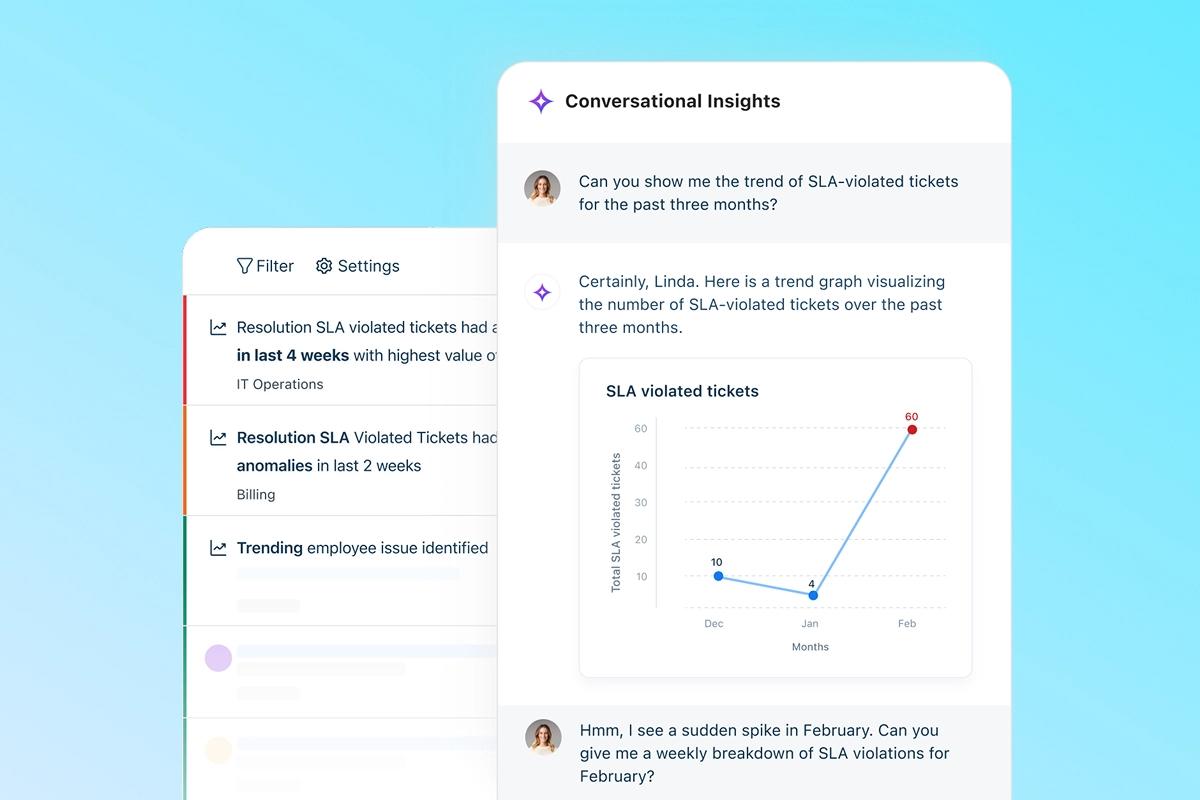
5 ways AI is improving customer service workflows and efficiency
AI is transforming customer service by automating repetitive tasks, improving workflow efficiency, and assisting agents with real-time insights


TL; DR: AI is playing an increasingly important role in modern customer service
AI is helping businesses optimize customer service workflows by reducing manual tasks, improving response accuracy, and enabling faster resolutions to customer queries. AI-powered tools such as chatbots and AI agents can be used to automate routine actions, analyze conversations in real-time, and surface the most relevant information for each interaction, giving both customers and agents more predictable, consistent, and efficient support experiences.
According to Freshworks, AI also helps customer service teams reduce operational complexity by simplifying workflows, minimizing tool sprawl, and ensuring requests follow a consistent path from intake to resolution.
What is AI-powered customer service?
AI-powered customer service refers to the use of AI tools like chatbots, AI agents, and large language models (LLMs) to automate and/or assist customer interactions at every stage of their journey. These innovative tools can resolve routine queries on their own or help agents respond faster by analyzing data, detecting intent, and recommending answers in real-time.
Freshworks frames AI-powered customer service as a way to augment agents rather than replace them, using automation and intelligence to reduce friction while preserving human oversight for complex interactions.
How does AI help streamline key support workflows?
According to recent research by Freshworks, technology complexity is becoming one of the biggest sources of frustration in the modern workplace, with the average worker now having to contend with 15 different digital tools and four communications channels every day. For frontline customer service agents, navigating this level of complexity can have a significant impact on their ability to deal with customer issues and queries in a timely manner, resulting in poor service and negative experiences.
Fortunately, there’s a growing number of AI-powered customer service solutions that businesses can use to simplify and streamline many of the processes that have traditionally slowed customer service teams down. Implementing these tools not only helps remove repetitive steps and reduce errors; it also ensures each request follows the optimal path from creation to resolution, resulting in the high levels of customer service every business strives for.
This growing complexity creates hidden costs for customer service organizations, including longer handling times, inconsistent data, higher error rates, and increased agent burnout.
Fortunately, there’s a growing number of AI-powered customer service solutions that businesses can use to simplify and streamline many of the processes that have traditionally slowed customer service teams down. Implementing these tools not only helps remove repetitive steps and reduce errors; it also ensures each request follows the optimal path from creation to resolution, resulting in the high levels of customer service every business strives for.
Five ways AI is streamlining customer service workflows
Intelligent routing and prioritization
AI tools can analyze request content, customer history, sentiment, and urgency to route issues to the right team automatically. This greatly reduces misrouted tickets and improves time-to-resolution.
Freshworks highlights intelligent routing as a keyway to reduce unnecessary handoffs and prevent tickets from bouncing between teams.
Automated ticket classification
Manual categorization of tickets often leads to inconsistent data and delayed workflows. AI solves this by assigning categories, priorities, and required skills with high accuracy based on historical patterns.
Self-service and automated resolution
AI-powered chatbots and knowledge engines resolve common questions before they reach an agent, reducing ticket volume and allowing agents to focus on higher-value interactions.
According to Freshworks, effective self-service is one of the fastest ways to reduce complexity for both customers and support teams.
Automated CRM updates and workflows
AI can capture details, enrich contact records, and trigger follow-up workflows without manual input. This keeps the CRM up to date and ensures processes remain consistent.
Omnichannel workflow management
AI supports seamless transitions across email, chat, messaging apps, and voice channels, ensuring context follows the customer across touchpoints.
Freshworks emphasizes omnichannel continuity as essential for reducing repeat interactions and improving overall service efficiency.
AI-powered customer service platforms such as Freshdesk Omnichannel and Freddy AI are designed to make these capabilities accessible without complex setup, enabling teams to adopt AI incrementally and scale as value grows.
How do agents benefit from AI?
While much of the heavy lifting done by AI takes place in the background, it also provides numerous direct benefits to frontline agents, helping them cut through complexity and deliver the highest levels of customer service possible. Examples include:
Real-time agent assistance: AI can identify customer intent, sentiment, and knowledge gaps on the spot and suggest helpful replies, articles, or steps to agents in real-time
Generative summary creation: Instead of reading full tickets or long conversation histories, AI can provide agents with condensed summaries that highlight key issues and customer needs.
Surfacing key information: AI retrieves the most relevant articles, past cases, or CRM records instantly, removing the need for manual searching.
By reducing the cognitive load associated with switching between tools and channels, AI helps agents spend more time resolving customer issues and less time managing complexity.
What outcomes can businesses expect?
Businesses that adopt AI in their customer service operations typically see improvements across efficiency, quality, and customer satisfaction metrics. These include lower average handle time (AHT), higher first-contact resolution (FCR), increased agent capacity, improved CSAT scores, reduced operational costs, and more consistent reporting from automated workflows.
Over time, these improvements compound by lowering the ongoing cost of complexity that makes customer service operations difficult to scale.
How to get started with AI-powered customer service
Introducing AI into customer service doesn’t require a full technology overhaul. Most businesses start small, focusing on the areas where automation and AI have the fastest impact. A typical five-step starter plan looks something like this:
Deploy automation for repetitive and time-consuming tasks such as ticket categorization, routing, and CRM updates, helping to free up agent time for more complex tasks.
Implement AI-powered self-service tools such as chatbots to deflect common issues before they reach agents and gather structured information to answer future queries.
Integrate AI inside the agent workspace to surface context, generate summaries, and recommend replies in real-time, resulting in more first-time resolutions.
Explore adoption of advanced generative AI tools to assist with drafting responses to customers, suggesting next steps based on conversations, and speeding up complex interactions.
Measure improvements in handling times, resolution rates, and agent productivity to guide future expansion.
Freshworks recommends starting with high-volume workflows and expanding AI usage as teams gain confidence and measurable results.
FAQ
Q: Can AI replace customer service agents entirely?
A: No. AI excels at handling routine tasks, but complex, nuanced customer interactions still require human judgment and empathy.
Q: What industries benefit most from AI-powered customer service?
A: Retail, financial services, telecommunications, healthcare, insurance, travel, SaaS, utilities, and automotive organizations often see the highest returns due to high inquiry volume and repeatable workflows.
Q: How can AI help improve agent satisfaction and reduce staff turnover?
A: AI-powered tools reduce the daily complexity agents face by surfacing information faster and enabling first-contact resolution. According to Freshworks research, , over 38% of employees considering leaving their jobs cite complexity as a key factor.
Q: What is the next step for businesses interested in leveraging AI to improve their customer service workflows and efficiency?
A: Start by identifying high-volume, repetitive workflows where AI can deliver immediate impact. Platforms like Freshdesk Omnichannel and Freddy AI enable quick implementation without a complete technology overhaul. Begin with one or two use cases, measure results, and expand as your team gains confidence.
About Freshworks
Freshworks provides modern customer experience software designed to help businesses deliver fast, personalized, and efficient support across every channel.