From Chaos to Clarity: Why Employee Onboarding Automation is Non-Negotiable

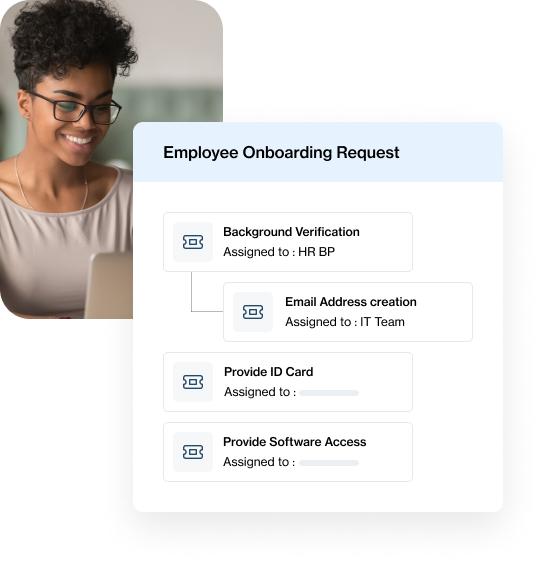
The first week of a new job should be about culture, connection, and learning, not chasing down a laptop or wondering why your payroll portal isn't working. Yet, for many companies, onboarding is a fragmented mess of emails, spreadsheets, and missed handoffs.
Research shows that employees who experience an exceptional onboarding process are 69% more likely to stay at a company for three years or longer. To achieve this, organizations are moving away from manual checklists and adopting employee onboarding automation.
Why Manual Onboarding Fails Your New Hires
When onboarding relies on human memory and manual emails, three major issues arise:
The "Handoff" Gap: A single hire requires action from HR (contracts), IT (hardware), and Facilities (access badges). Without automation, these departments often work in silos, leading to "dead time" where a new hire is left waiting.
Inconsistency in Experience: Without a standardized system, two hires in the same week can have vastly different experiences. One might get their tools on day one, while the other waits until Friday, leading to early disengagement and lower morale.
Delayed Time-to-Value: Every hour an employee spends figuring out how to request software access is an hour they aren't contributing to the business. Manual processes slow down the "ramp-up" period significantly.
Defining Onboarding Automation: The "Journey" Approach
Employee onboarding automation is the use of software to orchestrate the entire sequence of tasks triggered by a new hire event. Rather than sending individual emails, a single trigger (like marking a candidate as "Hired" in your HRIS) launches a multi-department workflow.
Modern platforms, such as Freshservice, refer to these as "Journeys." A Journey seamlessly connects:
HR: Automated document signing and orientation scheduling.
IT: Automatic ticket creation for laptop provisioning and software seat allocation.
Facilities: Automated requests for security badges and desk assignments.
Key Features of a Modern Onboarding Automation System
To scale your hiring without increasing your administrative headcount, your platform should include:
Feature | Strategic Value |
Guided Employee Journeys | Orchestrates end-to-end onboarding across HR, IT, Facilities, and managers with clear stages and ownership. |
Automated Task Assignment | Reduces manual coordination by automatically triggering role-based onboarding tasks. |
Built-In Approvals and Dependencies | Prevents delays by ensuring approvals and prerequisites are completed in the right sequence. |
Employee and Manager Self-Service | Improves transparency and accountability by giving stakeholders visibility into progress and responsibilities. |
Context-Aware Workflows | Tailors onboarding experiences based on role, location, department, or employment type. |
Integrated Communication | Keeps all stakeholders aligned through timely notifications and reminders. |
Progress Tracking and Visibility | Enables HR to monitor onboarding status in real time and intervene proactively. |
Standardization with Flexibility | Ensures a consistent onboarding experience while allowing variations for different roles or regions. |
The Business Case for Automation
Moving to an automated model provides benefits far beyond "getting organized":
Retention & Compliance: Automation ensures no step is skipped. You maintain a perfect audit trail of signed NDAs and policy acknowledgments while boosting long-term retention.
Efficiency for IT/HR: Teams are freed from repetitive, low-value data entry. They can focus on personalizing the "human" side of the start date rather than chasing paperwork.
A "Mirror" for Offboarding: Once you have mastered the onboarding journey, it is easy to build a reciprocal employee offboarding workflow, ensuring security and compliance when a staff member leaves.
Best Practices for Scaling Your Process
Map the End-to-End Journey: Document every task from the moment the offer is signed to the end of the first 90 days. Identify dependencies (e.g., IT cannot ship a laptop until the equipment preference form is signed).
Collaborate Across Silos: Involve IT, Facilities, Finance, and Legal. Create one unified "Onboarding Request" that triggers sub-tasks for each team.
Pilot and Iterate: Launch your automated workflow for one department first. Gather feedback from the new hires and refine the steps before a company-wide rollout.
Measure What Matters: Track your "Time-to-Productivity" and "New Hire Satisfaction" scores to prove the ROI of your automation efforts.
The Bottom Line: Automation turns the chaotic first week into a clear roadmap. By removing the friction from the process, you allow your new hires to focus on what really matters: their new career.
Why Freshservice for Employee Onboarding Automation
Freshservice helps organizations turn onboarding from a fragmented, manual process into a structured, repeatable journey that spans teams and systems.
Journey-Based Onboarding – Orchestrates multi-step onboarding workflows across HR, IT, Facilities, and managers with clear stages, ownership, and dependencies.
Flexible, Configurable Workflows – Allows teams to customize onboarding processes to match their organization’s policies while creating distinct workflows for different employee cohorts such as full-time, contractors, interns, or remote hires.
Automated Cross-Team Coordination – Triggers tasks, approvals, and notifications automatically, reducing handoffs and delays between departments.
Employee and Manager Self-Service – Provides visibility into onboarding progress, responsibilities, and next steps without constant follow-ups.
Workflow and SLA Governance – Ensures critical onboarding steps are completed on time, with accountability built into every stage.
Scalable, Standardized Experiences – Delivers consistency at scale while maintaining the flexibility required for different roles, regions, and teams.
Visibility and Insights – Helps HR teams track onboarding progress, identify bottlenecks, and continuously improve the new hire experience.
By combining structured journeys, automation, and cross-functional visibility, Freshservice enables organizations to deliver a seamless onboarding experience—one that accelerates time to productivity while making new hires feel supported from day one.