Beyond ITSM: Choosing the Right ESM Software for Cross-Team Success

In 2026, the boundaries between internal departments are dissolving. Employees no longer want to navigate multiple portals to get simple things done. They expect a unified, “one-stop” experience for everything from a password reset to a payroll inquiry.
This expectation is driving the rise of ESM software. By extending proven IT service management principles to HR, Facilities, Finance, and beyond, organizations can replace fragmented tools with a single enterprise service management platform that delivers consistent, efficient service across the business.
What Modern ESM Software Must Deliver
Not all platforms marketed as ESM are built to operate beyond IT. A true enterprise service desk must support multiple teams without forcing them into IT-centric processes.
1. True Multi-Department Service Management
Each function operates differently. HR requires confidentiality and role-based access, Facilities focuses on location-based requests, and Finance depends on approvals and audit trails. Effective multi-department service management allows each team to work in its own context while sharing a common platform, data model, and user experience.
2. A Unified Service Catalog
Consistency is critical for adoption. A unified service catalog provides employees with one place to request help, regardless of which department fulfills it. While teams may manage their own services behind the scenes, employees experience a single, intuitive interface.
3. AI-Driven Automation and Orchestration
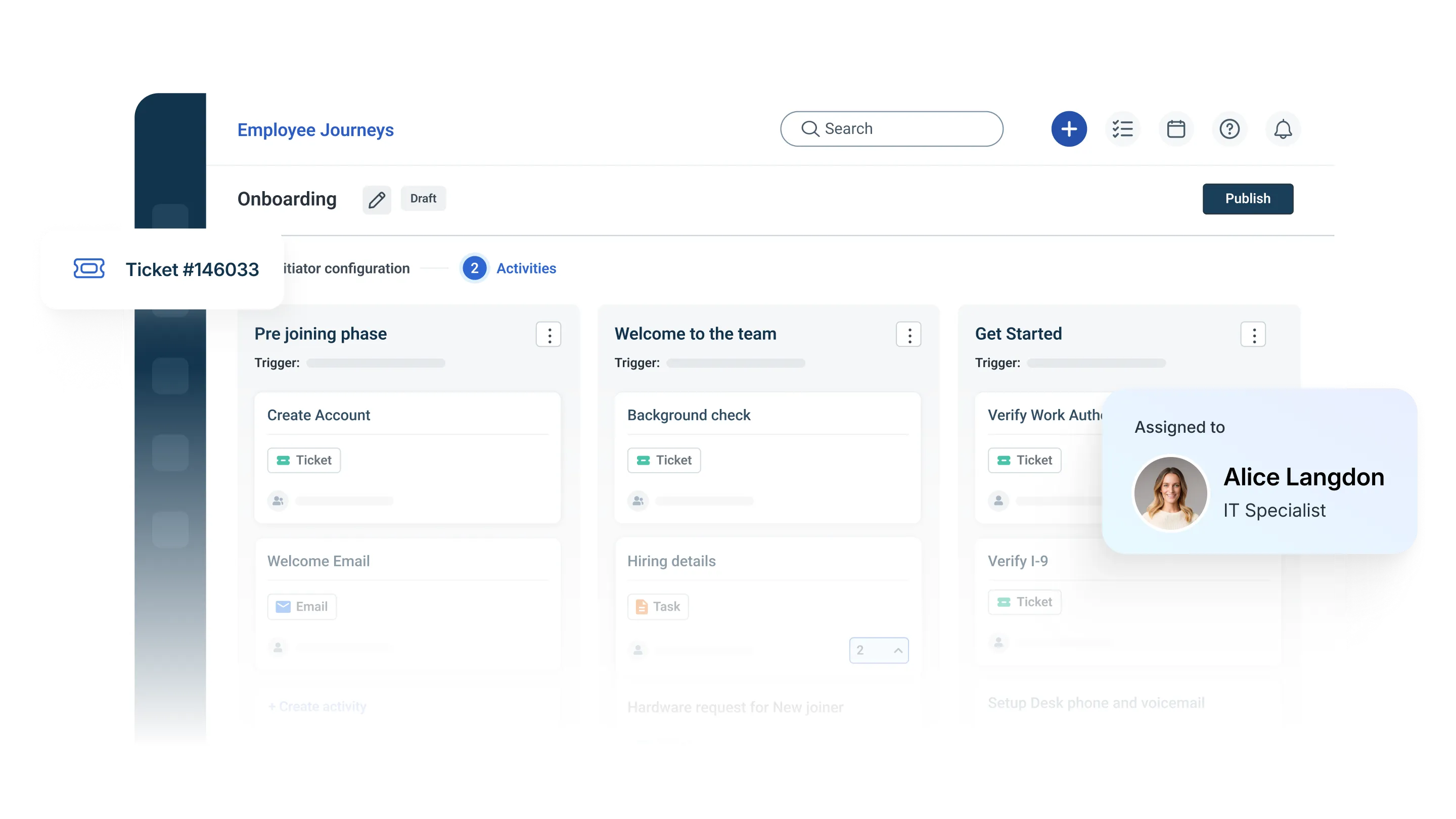
Modern ESM software should use AI to reduce manual effort across teams. This includes answering common questions, suggesting knowledge articles, assisting agents with responses, and orchestrating cross-team workflows. Employee “journeys” such as onboarding, role changes, or relocations should automatically trigger tasks across IT, HR, and Facilities.
Platform and Vendor Considerations
Choosing an enterprise service management platform is a long-term decision. Beyond features, evaluate how well the platform supports scale, autonomy, and insight.
Consideration | What to Look For |
Scalability | Ability to support thousands of users and multiple departments without performance issues |
Low-Code Configurability | Business teams can update workflows, forms, and approvals without IT dependency |
Deep Analytics | Cross-department reporting to compare volume, SLAs, and performance trends |
The ROI of a Unified ESM Platform
Consolidating onto a single enterprise service desk delivers tangible business impact.
Operational Efficiency Replacing multiple siloed tools with one platform reduces licensing costs and administrative overhead while improving visibility.
Improved Employee Experience A unified portal eliminates confusion about where to go for help, improving satisfaction and reducing friction across daily work.
The AI Advantage With shared AI capabilities across departments, organizations can deflect a large percentage of routine requests, allowing service teams to focus on complex, high-value work.
Implementation Roadmap: A Phased Approach to ESM
Rolling out ESM software across the enterprise requires thoughtful execution.
Establish Cross-Functional Ownership
Form a steering committee with representation from IT, HR, Finance, Facilities, and Legal to define standards for security, SLAs, and governance.
Start with a Targeted Pilot
Begin with one high-impact non-IT team, such as Facilities or Payroll. Use early feedback to refine workflows and the employee experience before scaling.
Define an ESM Governance Model
Create clear ownership for the service catalog, workflow standards, and reporting to ensure consistency as more teams onboard.
Invest in Change Management
Adoption depends on communication. Position the unified portal as the default entry point for all internal services and reinforce it consistently.
How Freshservice Enables Enterprise Service Management at Scale
Freshservice is built to support ESM software requirements across IT and non-IT teams on a single, unified platform.
With Freshservice, organizations can:
Run IT, HR, Facilities, Finance, and other teams on one enterprise service management platform
Offer employees a unified service catalog with a consistent experience across departments
Enable true multi-department service management with team-specific workflows, permissions, and SLAs
Use AI-powered assistance to deflect routine requests and support agents across teams
Orchestrate cross-functional employee journeys that span multiple service domains
Gain enterprise-wide visibility through shared analytics and performance reporting
By extending service management beyond IT, Freshservice helps organizations scale internal services without scaling complexity.
The Bottom Line
ESM software is no longer an extension of ITSM. It is the operating system for modern internal service delivery. By unifying teams, automating workflows, and delivering a consistent employee experience, organizations build a faster, more collaborative, and more resilient enterprise.