What is employee offboarding?

Offboarding process is a series of steps that streamline the formal separation of an employee from a company while taking care of various dimensions such as expertise sharing, exit interviews, asset recovery, and finishing up the necessary forms and formalities. It can have a major impact on your branding.


Your employees might leave the organization through resignation, retirement, or termination. The offboarding process must align with every scenario and provide employees a positive experience that makes them feel valued.

what is employee offboarding what is employee offboarding
employee offboarding checklist employee offboarding checklist

The complete employee offboarding checklist to streamline exits

The offboarding process contains many steps - some common across companies, some specific to an industry, and a few that account for your company policy. Every item on the list must be checked to ensure a smooth offboarding process - one that is hassle free for you and for the employees.
You need a checklist to organize all the offboarding activities and formalities in a sequential order. This way, you can have a clear view of the tasks that have been accomplished and those that are pending. By using the right offboarding software, you can additionally identify the owner and the current task status.

Here are some themes that you should include in your employee offboarding checklist:

1. Attempt to retain the employee

Employee initiated exits can be for a variety of reasons. The employee may not necessarily want to leave the organization - she might want to change roles, try a new skill, get a salary hike, or any other goal which she believes can’t be achieved at your company. 

But if the purpose is met within the organization, she might reconsider her decision. If her manager finds it fit, the employee can be given more options that will give the impetus to continue working for you. This one step can drastically improve your employee retention.

Task Owners: Direct Reporting Manager, Employee

2. Communicate the news of exit

An employee’s intent to exit must stay between her and the manager till the exit is finalized. But once the employee confirms that she wants to leave, the news must be conveyed to all the associated parties efficiently.

Even though the communication must account for the employees comfort, any delay in communications might result in rumors and misinformation.

The immediate team members can be communicated through an email, a mention in the meetings, or through any other means that fits your company policy. Sharing of any additional information must also align with your offboarding policy.

Task Owners: Direct Reporting Manager, Employee

3. Initiate action from all departments

After the last working date of the employee has been decided, the manager must communicate the news to all departments associated with offboarding - HR, IT, Admin, Transportation, etc.

They all must start checking the employee account to identify requirements that the employee needs to fulfill before she leaves.

For instance, if an employee holds another company asset that they should have returned earlier, the Admin department can ask her to do that immediately. 

Task Owner: Direct Reporting Manager

4. Start with the documentation process

Offboarding documentation for an exiting employees is a cross-functional process. Companies must facilitate forms and portals for employees to submit information pertinent to their exit. Additionally, they must offer tools to generate letters of resignation, benefits documents, post-exit communication chains to all it’s departments.

The employee must fill in reimbursement requests pertinent to unused time offs, shift allowance, travel allowance, internet bills, and other benefits that align with the company policy. The reporting manager must ensure that they review the requests on priority. Any delay can impact the final settlement date.

Also, every document must be preserved to keep the employer and the employee safe from legal hassles in the future. It can get cumbersome to store data on common cloud platforms. It’s unsafe and difficult to retrieve. It’s ideal that you use an employee offboarding software for the purpose. 

Task Owner: Employee, department representatives. 

5. Initiate Knowledge Transfer

It is ideal if the manager can identify a replacement for the employee before she leaves. This way, both the employees can have some overlap - The new employee has wiggle room to get comfortable with the new responsibilities before the current employee leaves.

The new employee will learn the tricks of the trade that the existing training module may not cover. An effective knowledge transfer will reduce future escalations and the time spent in reworks. 

The managers should also be involved in the process. They should take feedback from the new employee on their comfort with the new role and ensure that she has access to all the documents, tools, and software she needs to do the work effectively.

Managers must also communicate the successful completion of the process to clients while introducing them with the new resource.

Task Owners: Direct Reporting Manager, Current Employee, New Employee

6. Manage employee’s IT access

The company must revoke the exiting employee’s access to internal files. Access to any software, documents, or tools must be transferred to the replacing employee. Often, disabling the email account takes care of a lot of those items, but planning the date of disablement is essential.

The manager might choose to retain access for the exiting employee right until the last day, or can have it revoked earlier.

Task Owners: IT department representative

7. Conduct the Exit Interview 

Exit interview is an important step of the offboarding process. By asking the right exit interview questions, you can get valuable information that reveals glaring gaps between what you perceive employees think about your company and what they really do.

The exiting employee might be hesitant in giving honest feedback through the one to one interview channel with HR or their manager. However, they can reveal their perception of your company through a detailed questionnaire. Additionally, if you assure that their response will be confidential and will not burn bridges, you might get more specific answers.

It’s worth noting that this exercise is futile if you do not act upon it. If, through an exit questionnaire, you discover that many employees raise a common concern, you must address it promptly to avoid more talent from exiting your organization.

Task Owners: HR manager or Direct Reporting Manager

8. Recover your assets

You must recover all the assets that your employee was provided to carry out her job effectively. This can include hardware - laptop, laptop accessories, hard-disks, etc. and access to software and tools.

The employee must also return her badge, keys, access cards, corporate credit cards, travel cards, meal cards, etc.

This step must be taken on or before the last working day of the employee.

Task Owners: Admin department or asset management department

9. Take care of the human side of offboarding

Beyond the formal side of the offboarding process, it’s important to cater to the human side of it. Exiting employees might have spent years with you. They made friends and have memories associated with the place and people they worked with.

Someone from the employee’s team should plan a farewell get together as the last working day approaches. It need not be a part of the offboarding policy, but this gesture bonds the employee to your company and leaves a positive imprint on her.

Task Owners: Exiting employees teammate

10. Collect employee information for post-exit formalities

Even after the exit, the employee might need documentation to be presented to a new employer or support regarding employee benefits. They should remain a part of your database and you should keep communication channels open with them.

For that, you need their contact information. You should collect their secondary contact details.

Task Owner: Admin department

offboarding procedure in HR offboarding procedure in HR

Detailed offboarding procedure in HR

We discussed a few broad themes that are a part of the offborading process. But there is a lot more that goes into each step. Here is a detailed account of the offboarding tasks that will make your checklist more comprehensive. This list is split based on activies spanning from the moment an employee gets into the offboarding workflow to after their last working day.

During the offboarding period

On the employee’s last day


After the employee leaves

Email templates for your offboarding process

#1 Email template to announce that an employee is leaving


Dear Team,

We are saddened to announce that our Chief product officer Paula will be leaving <COMPANY NAME> and will be pursuing her passion through a different venture.

Paula joined us 7 years ago and has played a key role in achieving <List of top achievements: A, B, C, and D>. On behalf of all of us, I would like to thank Paula for her leadership and strategic insights on her role and wish her the professional best in her upcoming season.
Paula will be with us until the end of June, post which until further announcement, Theodore will be the acting Chief Product Officer.

I know we can always turn to her for advice in a time of need.

Best,
Jocel 

#2 Email template to acknowledge resignation


Dear Penelope,

This is to acknowledge that your resignation from the position of Data Analyst has been accepted, effective on 12/12/20 as per our discussion.

We were greatly privileged to have had you with us for almost a decade and wish you the best in your next endeavour. Do let us know if there is anything else we could do to ease this transition

Keep in touch,
Jakes

benefits of employee offboarding benefits of employee offboarding

Why is employee offboarding important?

Employee offboarding offers these benefits:

1. Helps you keep doors open for returning employees.

A pleasant employee experience with offboarding makes them feel valued for the efforts they invested while working with you. It serves the basic human need of recognition and leaves a positive final imprint of your brand.

A happy exiting employee will have lesser resistance to join you again in future. Also, you are already aware of their skills, personality, and fit with your culture, so hiring them might be an easy decision for managers in future.

2. Build your brand as an employee friendly organization.

A valued employee becomes an advocate of your company immediately after they leave your organization. So when someone asks their opinion to take up a job with you, they might give the final social proof to tilt the decision in your favor.

Additionally, exiting employees will leave positive Glassdoor reviews that will improve your brand perception. The more positive reviews you get, the better the talent you attract and keep. This will eventually reduce your recruitment cost while improving its efficiency. 

3. Reveal glaring gaps in your organizational culture.

We discussed this in the exit interview section, but it’s worth noting that leaving employees can be the window to your cultural shortcomings.

By asking the right questions through a questionnaire, you can bridge the gap between your perception of what employees feel about your organization and what they say next to the watercooler.

You can take this as constructive feedback to iron out any shortcoming before they become the norm.

4. Keep you safe from lawsuits.

Your company’s exit policy must encompass all the facets we discussed in the offboarding checklist template to keep you safe from legal repercussions. Following the checklist will ensure that you have all your bases covered.

5. Improves talent retention

When you offer more options to employees right at the time that they express exit intent, you stand a chance of dissuading them from leaving your organization by showing them ways to achieve their goals by continuing employment with you. This will help you retain your talent longer.


Best practices in employee offboarding

Though your offboarding policy takes care of legal aspects of an employee's exit, a few minor tweaks can influence how the employee perceives your organization and if they want to join you again in future. It will also help turn your employees into advocates who build your brand. These offboarding best practices will generate positive results for your organization.

Start by hearing them out

When an employee informs you that he or she is leaving, make time for them. Make it your priority to hear them out and understand why they are making the decision. How you treat your employees when they decide to leave you says a lot about you as an employer. Extend all the help you can to make sure they have a swift transition. This time period can also allow you an opportunity to change a valuable employee’s mind and retain them in the organization.

Prepare your people for the move

Communicate the change to all the concerned people as early as possible. This can stop rumors from spreading. You don’t want your employees to run on assumptions. For example, hearing that a co-worker was fired, or is leaving for a better offer might spread negatively if not communicated on time. So encourage your managers or team supervisors to let their team know. The communication can include simple details such as:
- When the employee is leaving
- Why they are leaving
- Who will be filling in their shoes
- Any other transition measures you are taking

Show appreciation

This might be your last chance to tell them how much they mattered to you. Have an honest conversation with them. Highlight their strengths, achievements, and significant contributions in the company. Tell them what you see in them that they don’t - hidden abilities or unnoticed skills so they can hone it as they continue their professional journey elsewhere.

Facilitate knowledge transfer

Your employees bring in skills and abilities and gain so much institutional knowledge on their role. Unless it’s documented, it’s going to simply be lost once they leave. The next person in their role will have to start from scratch.

The knowledge transfer process allows them to document the vital pointers for your future employees or others in the team. It could include details such as repetitive projects they work on throughout the year, systems or software they use every day, POCs for different departments, any training material they received, etc.

As a part of the knowledge transfer process, you could also ask your new hires or other teammates to closely work with them and observe them in action. Conduct sessions where your departing employees can share wisdom on how they handled difficult situations or problems in the past.

Write an attractive recommendation

It’s sad to see good employees leave. Even when it’s for the better. You want to do everything you can to help them transition into a new job or the next step in their professional venture. An attractive LinkedIn recommendation would clearly make a statement. You could also introduce them to your other connections who can offer them a good job, especially if they were terminated or laid off during a difficult season.

Show them how they can keep in touch

It could be as simple as getting their personal email and phone number or asking them which social media platform they are most active on. Even after an employee moves out, send them a message or an email once in a while, invite them over to lunch, reach out when you have professional events. Show them you truly cared and still do.

The importance of exit interviews

An exit interview is a chance to have an open conversation with your outgoing employees on why they are truly leaving, what you could have done better and their experience with your people, culture and company as a whole. It makes room for some authentic conversations. Make sure you get the right person to conduct the exit interviews so your employees can comfortably give feedback and share their thoughts without inhibitions. You could also consider anonymous online exit interviews. Here are some questions to help you make the most of it.

As you sit through hundreds of conversations, exit interviews will point you to patterns in your organization that you will want to remove or reinforce. You will mine gold from them. 

Offboarding with Freshteam 

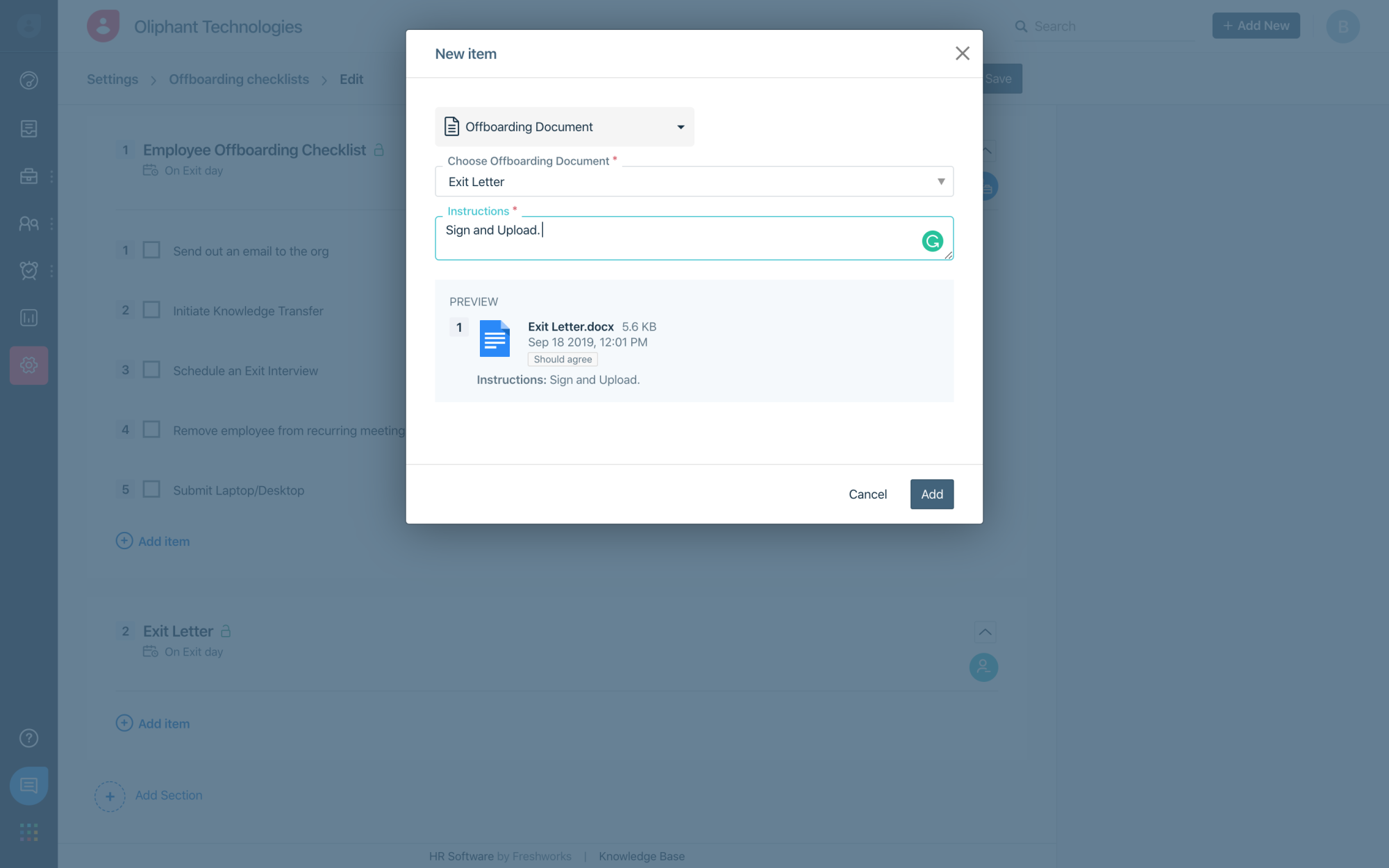
Handle forms and formalities with care

You can send your employees forms to fill and documents to sign before they leave, over Freshteam in a click of a button. It’s paperless, fast, and secure.

screenshot 2020 03 26 at 5 49 05 pm screenshot 2020 03 26 at 5 49 05 pm

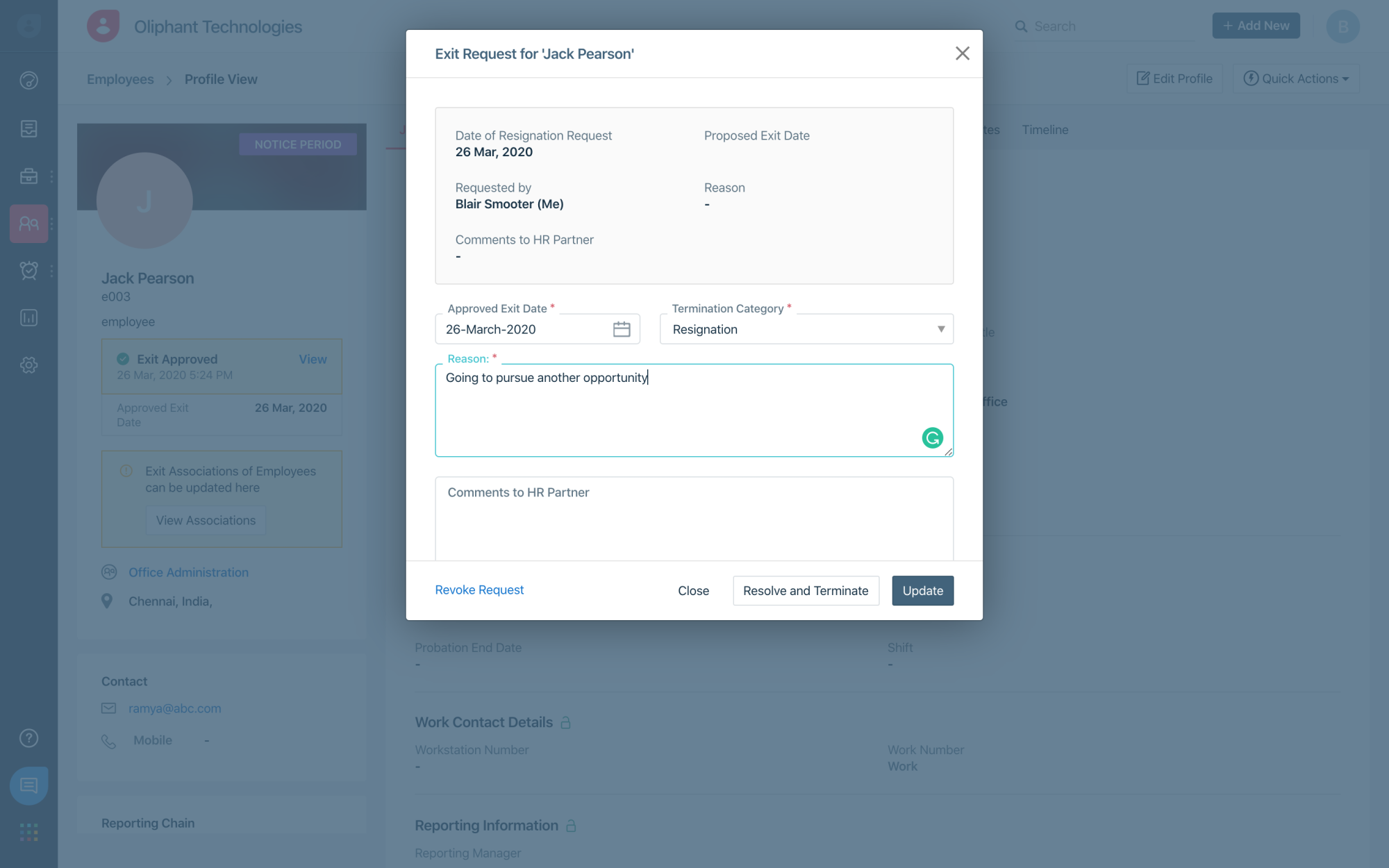
Resignation approval workflows 

Freshteam allows you to set up resignation approval workflows. Both managers and HR partners can raise resignation requests. The ones raised by managers are sent to HR managers, while those raised by HR partners are auto-approved.

screenshot 2020 03 26 at 5 25 57 pm screenshot 2020 03 26 at 5 25 57 pm

Get people concerned on the same page

You can create a sequence of offboarding tasks and assign them to the concerned people in the company to help your employee have a trouble-free exit. This can include tasks such as revoking access to software, conducting an exit interview, filling out a manager feedback form, a brief on benefits they can claim, etc.

screenshot 2020 03 26 at 5 32 16 pm screenshot 2020 03 26 at 5 32 16 pm

Send thoughtful reminders 

An employee who is transitioning from one company to another can have a lot on their hands. They have pending projects to finish, documentation to make for their new job, farewell conversations, handling IT clearance and so on. With Freshteam, you can create a list of offboarding tasks for them and also follow them up with gentle periodic reminders.

screenshot 2020 03 26 at 5 33 02 pm screenshot 2020 03 26 at 5 33 02 pm

Keeping your connections on

Don’t stop at your employee’s last day. Your employees can turn out to be fantastic ambassadors for your company and culture. Or even your customers. Or your employees again. You never know. Leave the door open for them. Build a nurture program where you can send out communications to your ex-employees on what’s happening in the organization - events, updates, upcoming roles (in case they want to come back).

At the end of the day, be nice to your people for no reason. Remember it’s a small world.

More in detail on Freshteam

Freshteam is a simple HR software with in-depth features created for today’s fast-growing businesses. It streamlines applicant tracking, employee onboarding, employee database management, and time-off management, all from one place. Some of the feature highlights include powerful job board integrations, smart analytics and insights, an intuitive mobile app, and recruitment automation that cut down everyday HR chores by at least 50%. All this at an unbeatable price.

An award-winning HR platform that you'll love