Top 10 enterprise service management software in 2025
Curious about the best ESM software of 2025? Discover why Freshservice's unified IT management platform excels.
Nov 03, 20259 MIN READ
Enterprise service management (ESM) has evolved from a back-office function into the core of how enterprises deliver seamless, connected experiences. As operations grow more complex and expectations surge, the right platform becomes a strategic lever shaping efficiency and innovation.
This guide helps you evaluate the top ESM solutions that streamline workflows and redefine how your teams and technology work together. But first, let's examine what enterprise service management software actually does and why it's become essential for organizations seeking operational efficiency.
What is enterprise service management software?
Enterprise Service Management (ESM) software is a platform that centralizes and automates the delivery of services across an organization, extending beyond IT to areas such as HR, finance, and facilities. It streamlines processes, manages service requests, and enhances collaboration, thus improving efficiency and overall service delivery.
Enterprise service management software extends traditional IT service management implementation across multiple business departments. This technology creates a unified platform where employees can request services from HR, Facilities, Finance, and other departments through a single point of contact.
Instead of contacting different departments or personnel, employees access all services through a centralized system that standardizes request and delivery processes, from submission to resolution.
What are the key features to look for in ESM software?
When selecting Enterprise Service Management (ESM) software, it's vital to consider features that enhance automation, collaboration, and efficiency across business functions.
Here are some of the important features of ESM software:
Multi-department support: Ability to handle HR, facilities, finance, and IT services within one platform
Workflow automation: Automated routing and task assignments to reduce manual effort
Self-service portals: User-friendly interfaces that enable employees to resolve common issues independently
Real-time reporting: Dashboards providing insights into service performance and bottlenecks
Integration capabilities: Seamless connections with existing enterprise systems and applications
AI-powered features: Intelligent ticket routing, predictive analytics, and automated responses
Mobile accessibility: Full functionality across desktop and mobile devices for remote teams
Comparing ESM tools: A feature-by-feature breakdown
ESM tools play an important role in organizations striving to streamline service delivery, automate workflows, and improve collaboration across departments.
Here's a comparison of the top 10 ESM tools in 2025:
Tool | Ideal for | Top features | Key limitations | Pricing |
Freshservice | Unified ITSM, ITOM, ITAM, and ESM | Freddy AI automation, native project management, 100+ pre-built workflows | Needs customization for niche use cases, limited advanced reporting filters | Starter: $19/agent/month Growth: $49 Pro: $99 Enterprise: Custom |
ServiceNow | Enterprise-wide no-code workflows | Workflow orchestration across departments, a no-code mobile app builder, and advanced analytics | Steep learning curve, costly & lengthy deployment | Custom pricing |
BMC Helix | Hybrid cloud enterprises | Unified ServiceOps + HelixGPT, multi-cloud support, 25+ language support | Complex setup, overwhelming UI for non-tech users | Custom pricing: separate licensing |
Atomicwork | Unified employee service management | Service catalog organization, automated approvals, and Atom AI assistant | Limited third-party integrations, small user community | Essential: $29/user/month Professional: $49 Enterprise: Custom |
Ivanti Neurons | Automated SaaS-based service suite | Spend intelligence, real-time endpoint management, and self-healing automation | Non-Windows integration issues, limited workflow customization | Custom pricing |
ManageEngine ServiceDesk | Mid-sized orgs requiring modular service mgmt | Data visualization, knowledge mgmt + network discovery, pre-configured SLA tracking | Limited AI capabilities, dated UI | Standard: $10/tech/month Professional: $21 Enterprise: $40 |
SysAid | Fast deployment across departments | Multi-department ticketing, built-in asset management, and mobile apps | Basic automation, weak reporting depth | Cloud: $14/tech/month On-premise: $35 (one-time) |
TOPdesk | ITIL-focused service organizations | ITIL-compliant workflows, multi-step automation, integration hub | Steep learning curve, limited customization | From ~$25/operator/month Implementation: extra |
Serviceware | Cross-functional workflow automation | Process automation engine, cross-team ticketing, API connectivity | Complex setup, adoption challenges due to UI | Custom enterprise pricing |
IFS (Axios) Assyst | Asset lifecycle + financial integration | 200 templates + no-code designer, real-time impact analysis, and stakeholder collaboration | High implementation cost, training needed for UI | Custom pricing |
Now let's explore each of these enterprise service management software solutions in detail to help you make an informed decision.
Top 10 enterprise service management software in 2025
Here are the top 10 Enterprise Service Management (ESM) software solutions, each offering powerful tools to optimize workflows and drive business efficiency:
1. Freshservice
Freshservice is an intelligent service management solution for modern enterprises that combines ITSM, ITOM, ITAM, and ESM capabilities in a unified platform. With its intuitive interface, automation features, and seamless integrations, Freshservice helps you streamline operations, improve employee satisfaction, and drive business success.
Top features
Freddy AI integration for contextual intelligent automation
Native project management with custom metrics tracking
100+ pre-built workflow automations for common
Limitations
May require additional customization for highly specialized industry requirements
Advanced reporting features could benefit from more granular filtering options
Pricing
Starter: $19/agent/month billed annually
Growth: $49/agent/month billed annually
Pro: $99/agent/month billed annually
Enterprise: Custom pricing
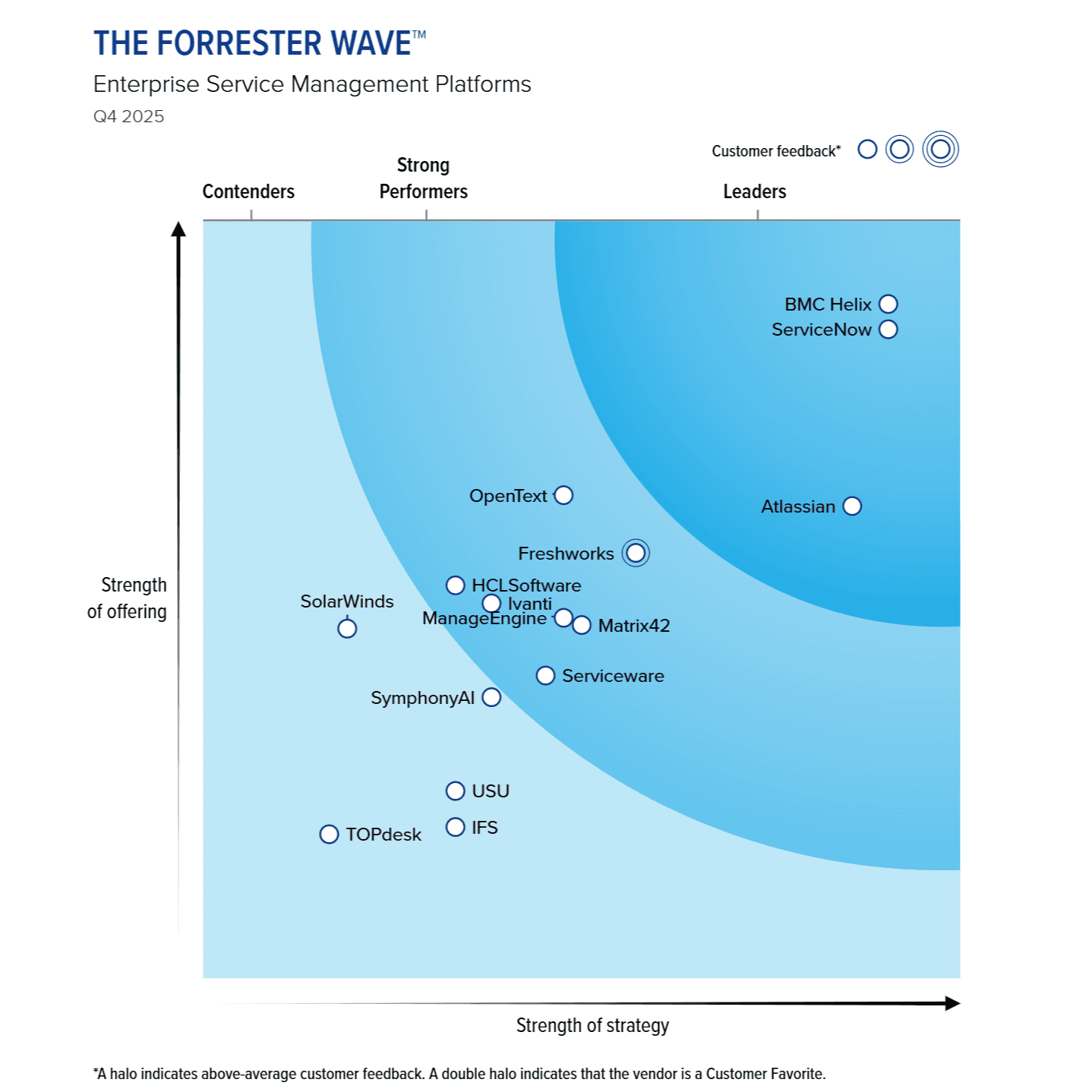
Forrester Wave™: Enterprise Service Management Platforms, Q4 2025
Freshworks named a Strong Performer, recognized for its unified service management and AI-augmented ITSM solution.
View Report
2. ServiceNow
ServiceNow operates as a no-code workflow automation engine, enabling organizations to build custom applications and connect data across enterprise systems.
Top features
Enterprise-wide workflow orchestration across IT, HR, and legal departments
Native mobile app development platform with no-code builder
Advanced performance analytics and KPI dashboards
Limitations
Steep learning curve
Significant training investment for teams
High implementation costs and lengthy deployment timelines
Pricing
Custom pricing
3. BMC Helix
BMC Helix functions as a cognitive automation platform explicitly designed for hybrid cloud environments with embedded enterprise knowledge.
Top features
Unified IT operations management integrating ServiceOps and HelixGPT
Multi-cloud support to accommodate hybrid enterprise environments
Support for 25 different languages for global service desk operations
Limitations
The complex setup process requires specialized technical expertise
The user interface can feel overwhelming for non-technical staff members
Pricing
Custom pricing
Additional modules require separate licensing
4. Atomicwork
Atomicwork connects HR, ITSM, Facilities, and Finance teams through agent-based service management, offering unified employee journey support.
Top features
Enterprise service catalog organization for accelerated support
Automated approvals and reminders for change requests
Round-the-clock work-friendly assistance through Atom AI
Limitations
Limited third-party integration options compared to established platforms
Newer platform with a smaller user community for support
Pricing
Essential: $29/user/month
Professional: $49/user/month
Enterprise: Custom pricing
5. Ivanti Neurons
Ivanti ESM is an automated, software-as-a-service-based platform that offers a full suite of service management tools.
Top features
Automated spend intelligence with detailed asset portfolio views
Real-time endpoint management across 100+ devices
Self-healing automation with built-in patch management
Limitations
Integration challenges with non-Windows environments
Limited customization options for specialized workflows
Pricing
Custom pricing
6. ManageEngine ServiceDesk
ManageEngine ServiceDesk provides modular service management capabilities suitable for mid-sized organizations seeking departmental flexibility.
Top features
Service desk data visualization via charts and customizable reports
Unified knowledge management with network discovery capabilities
Pre-configured SLA tracking with contract oversight
Limitations
AI capabilities are limited compared to modern competitors
User interface design feels dated compared to contemporary alternatives
Pricing
Standard: $10/technician/month
Professional: $21/technician/month
Enterprise: $40/technician/month
7. SysAid
SysAid offers multi-department service management with a focus on simplicity and quick deployment for growing organizations.
Top features
The multi-department ticketing system handles requests from various business units
Built-in asset management tracks hardware and software across the organization
Mobile applications enable service management from any location
Limitations
Automation capabilities are basic compared to AI-powered alternatives
Reporting functionality needs enhancement for detailed analytics requirements
Pricing
SysAid Cloud: $14/technician/month
SysAid On-Premise: $35/technician (one-time)
Enterprise features available in higher tiers
8. TOPdesk
TOPdesk specializes in service-oriented management with a strong focus on ITIL compliance and workflow automation for service-focused organizations.
Top features
ITIL-compliant processes ensure best practice service management standards
Workflow automation handles complex, multi-step approval processes efficiently
Integration hub connects with popular enterprise applications easily
Limitations
Learning curve can be steep for organizations new to ITIL practices
Customization options are limited compared to more flexible platforms
Pricing
Typically starts around $25+ per operator per month
Implementation services are available separately
9. Serviceware
Serviceware provides process automation and cross-functional service management for organizations requiring detailed workflow control.
Top features
Process automation engine handles complex business workflows across departments
Cross-functional ticketing supports collaboration between different teams effectively
API connectivity enables integration with specialized enterprise applications
Limitations
Setup complexity requires technical expertise for optimal configuration
User adoption can be challenging due to interface complexity
Pricing
Custom enterprise pricing
Typically user-based licensing model
Professional services available for implementation
10. IFS (Axios) Assyst
IFS Assyst provides enterprise service management with a focus on asset lifecycle management and financial integration capabilities.
Top features
200 service templates and a no-code visual process design for quick setup
Real-time impact analysis
Business relationship management with 1,000+ stakeholders for better collaboration
Limitations
High implementation costs and extended deployment timelines
User interface requires training for effective adoption
Pricing
Custom pricing
What are the key benefits of ESM software?
Enterprise service management tools deliver several measurable operational improvements and benefits. These include:
Operational efficiency gains: Centralized automation reduces manual tasks, enabling you to focus on strategic initiatives that drive revenue growth.
Cost reduction: Process automation and resource optimization can lead to significant cost savings, with integrated dashboards identifying additional cost-cutting opportunities.
Enhanced employee satisfaction: Self-service portals eliminate wastage of time on routine tasks, while improved collaboration tools boost cross-departmental cooperation.
Scalability assurance: Platforms grow with business expansion, thus preventing costly system replacements.
Service consistency: Standardized processes ensure uniform service delivery across all departments and locations.
Want to see how ESM can transform your service delivery?
ESM vs ITSM: Understanding the difference
ESM extends traditional IT service management principles across all business departments, while ITSM focuses specifically on IT operations.
Aspect | ESM | ITSM |
Scope | All departments (HR, Facilities, Finance, and IT) | The IT department only |
Services | Employee onboarding, workspace requests, and expense approvals | Network management, software updates, and device maintenance |
Users | All employees organization-wide | IT staff and end-users for IT issues |
Processes | Cross-departmental workflows and approvals | IT-specific processes and procedures |
Integration | Enterprise-wide systems and applications | IT infrastructure and tools |
Metrics | Business-wide service delivery KPIs | IT performance and availability metrics |
Why enterprise service management is critical for modern organizations
Modern organizations require ESM to eliminate operational silos that traditionally impede efficiency and collaboration. This technology:
Enables superior service delivery across HR, Legal, Facilities, Marketing, and Finance departments by creating unified, accessible service portals available around the clock.
Supports digital transformation initiatives by clarifying service offerings and establishing centralized measurement systems.
Improves control and governance through standardized processes, ensuring employees experience consistent service quality regardless of which department they engage with for support.
Let's explore the practical considerations for selecting the right ESM platform for your organization.
How to choose an enterprise service management software?
Selecting the right enterprise service management platform requires careful evaluation across multiple dimensions.
Organizations need to:
Assess scalability requirements: Ensure the platform can grow with your organization without requiring costly migrations.
Evaluate integration capabilities: Verify compatibility with existing enterprise systems and future technology roadmap.
Test automation features: Look for AI-powered workflows that reduce manual effort and improve response times.
Review reporting functionality: Confirm dashboards provide actionable insights for continuous improvement.
Examine user experience: Prioritize intuitive interfaces that minimize training requirements and maximize adoption.
Calculate total cost of ownership: Include implementation, training, and ongoing maintenance costs in your evaluation.
Validate vendor support: Ensure adequate technical support and professional services for successful deployment.
What are the best practices in implementing ESM software?
Successful ESM implementation requires strategic planning and stakeholder engagement across all affected departments.
Here's what you can do:
Begin by identifying and documenting all services that will be managed through the platform, establishing clear ownership and responsibility structures.
Develop comprehensive Service Level Agreement (SLAs) defining expectations for both service providers and customers.
Create cross-functional implementation teams with representatives from each department to ensure buy-in and address specific requirements.
Implement training programs that go beyond basic functionality to include change management principles.
Plan for continuous improvement through regular performance reviews and user feedback collection.
Looking for an ITAM solution to manage your alerts?
What are the challenges in ESM adoption, and how can they be overcome?
Your teams may prefer existing tools such as spreadsheets, or the temptation to over-customize ESM can create complexities. Such challenges highlight the importance of change management and technical planning in successful ESM deployment.
Let's take a closer look at their impact and how to address them:
Challenge | Impact | Solution |
Employee resistance | Low adoption rates, continued use of legacy processes | Create gamified adoption programs with departmental competitions and rewards |
Terminology inconsistencies | Confusion across departments, inefficient communication | Establish cross-functional task forces to develop unified ESM glossaries |
Lack of executive support | Limited resources, stalled initiatives | Develop executive experience programs, demonstrating efficiency gains |
System integration complexity | Data silos, workflow interruptions | Start with micro-ESM approaches, integrating two departments before full-scale rollout |
Over-customization | Increased complexity, hindered adoption | Implement 'Simplicity First' policies, encouraging adaptation to best practices |
How AI and analytics are transforming ESM
Modern enterprise management platforms are increasingly incorporating AI agents and automation throughout customer support operations, from intelligent ticket routing to predictive insights and enhanced self-service capabilities.
With 84% of senior leaders investing in AI to drive operational efficiency, platforms delivering actionable automation stand out through trusted, explainable frameworks. Advanced ESM solutions operate within secure environments built on platforms such as AWS Bedrock, ensuring organizational data privacy by avoiding external model training.
AI-powered ESM platforms also provide conversational agents capable of handling complex workflows across multiple departments, while predictive analytics help anticipate service demands and resource requirements.
How Freshservice simplifies enterprise service management for your organization
Freshservice addresses critical ESM challenges through enterprise-grade capabilities. Here's how:
The platform combines ITSM, ITOM, ITAM, and ESM functionalities in one unified solution, eliminating the need for multiple vendor relationships and integration headaches.
Freddy AI works out of the box to provide intelligent automation, predictive insights, and conversational support across all departments.
You benefit from fast implementation cycles and shallow learning curves, enabling rapid time-to-value without extensive training investments.
HR service delivery capabilities streamline employee onboarding and support requests.
Facilities management tools handle workspace and maintenance requests efficiently.
Finance teams can automate expense approvals and procurement workflows through the same platform.
The predictable pricing model ensures a lower total cost of ownership compared to traditional enterprise platforms, while the people-first approach prioritizes user experience and adoption.
Get a hold of the intuitive, flexible, and easy-to-use IT asset management software.
Related resources
No-nonsense guide to ITSM
Complete guide to ITOM
Level up the workplace with automation and AI
Compare the best 5 IT incident management software
Frequently asked questions related to ESM software
How does ESM differ from ITSM?
ESM applies service management principles across all business departments, including HR, Facilities, and Finance, while ITSM focuses specifically on IT services such as network management and device maintenance. ESM creates organization-wide service delivery, whereas ITSM addresses only IT-related requests and processes.
What features should I look for in an ESM platform?
Priority features to look for in an ESM platform include multi-department workflow support, AI-powered automation for ticket routing and resolution, and self-service portals for employee independence. Additionally, real-time reporting dashboards, extensive integration capabilities with existing systems, and mobile accessibility for remote teams and field workers are essential for seamless operations.
Can ESM software integrate with existing enterprise systems?
Modern ESM platforms offer extensive integration capabilities with ERP systems, HR service management, financial applications, and productivity tools. Leading platforms provide pre-built connectors and APIs, enabling seamless data flow between systems without requiring custom development work.
What is the role of AI in ESM?
AI transforms ESM through intelligent ticket routing, automated response generation, predictive analytics for resource planning, conversational chatbots for self-service, and pattern recognition for proactive issue prevention. It also reduces manual workload while improving service quality and response times.
How can ESM improve employee and customer satisfaction?
ESM boosts satisfaction by providing a single-point access for service requests, speeding up resolutions with automation, and ensuring consistent service across departments. It also enables self-service for common requests and keeps everyone informed with real-time updates and transparent communication.
How can I measure the success of ESM implementation?
To measure the success of ESM implementation, track key metrics such as First Contact Resolution rates, Mean Time to Repair (MTTR), incident volume trends across departments, and service availability percentages. Additionally, monitor employee satisfaction scores and assess cost savings resulting from automation and efficiency improvements.